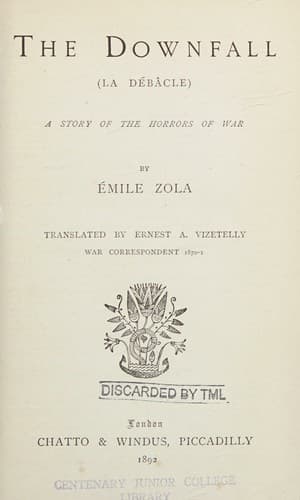
The Downfall (La Débâcle): A Story of the Horrors of WarZola, Émile
General
The Downfall (La Débâcle): A Story of the Horrors of War
Zola, Émile
Franco-Prussian War, 1870-1871 -- Fiction
Without taking part in the dispute, Jean considered the lieutenant
to be in the right. Though astonished by the long delays and the
prevailing confusion, he had never doubted that they would give the
Prussians a fearful thrashing. It was sure and certain, indeed, since
he and his comrades had been sent there for no other purpose.
'But I don't want to discourage anyone,' replied Weiss, somewhat
taken aback. 'On the contrary, I wish everyone knew what I know, for
forewarned is forearmed. But listen, Germany----'
Then, with that sober-minded air of his, he explained his fears: the
victory of Sadowa had brought Prussia increased power, a national
movement was placing her at the head of the other German States, a
vast empire was in progress of formation, men were seized with an
enthusiastic, irresistible impulse to secure the unification of the
Fatherland. Thanks to the system of compulsory military service the
whole nation was up in arms, fully instructed, well disciplined,
provided with a powerful war material, trained also to European
warfare, and still flushed with the glory of its triumph over Austria.
The intelligence and moral strength of this army were also to be
noted; nearly all the commanders were young men, and took their
orders from a generalissimo who seemed destined to revolutionise the
entire art of war, whose prudence and foresight were perfect, and
whose perspicuity was marvellous. Then, confronting Germany, Weiss
boldly depicted France: the Empire greatly aged, still acclaimed, as
witness the Plebiscitum,[7] but rotten at the basis, having weakened
love of country by destroying liberty, and having reverted to liberal
courses when these could be of no avail but could only accelerate its
fall; and exposed, moreover, to crumble away as soon as it ceased
to encourage the appetite for enjoyment which itself had fostered.
The army, still laden with the laurels of the Crimea and Italy, was
certainly splendidly brave; but the system of allowing men to escape
service by a pecuniary payment had tampered with its efficiency; and
it had been abandoned to the routine of the Algerian school, and was
far too confident of victory to make any real effort for proficiency
in the new science of war. Finally, the generals, for the most part of
indifferent merit, were consumed by rivalry, whilst some were crassly
ignorant, and at the head of them there was the Emperor, ailing and
hesitating, deceived by others and deceiving himself as to the outcome
of this frightful adventure, into which they all plunged like blind
men, without any attempt at serious preparation, and amid universal
bewilderment and confusion, like that of a scared flock driven to the
slaughter-house.
Public-domain text, read in full here on John Shaqi.
Reviews
Reviews
No reviews yet
Be the first to share your thoughts on this work.
Join the Discussion
Join the discussion
Sign in to leave a comment or review.
Sign InorCreate an account