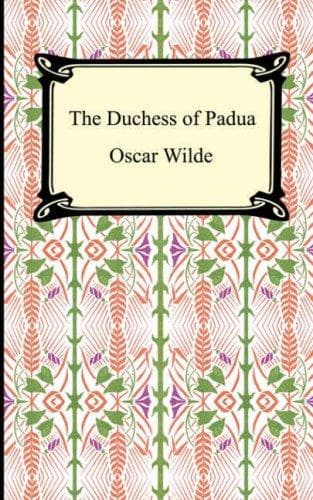
English drama -- 19th century; Padua (Italy) -- Drama; Revenge -- Drama; Tragedies (Drama)
Death,
Why do you tarry, get to the upper chamber;
The cold meats of my husband’s funeral feast
Are set for you; this is a wedding feast.
You are out of place, sir; and, besides, ’tis summer.
We do not need these heavy fires now,
You scorch us.
Oh, I am burned up,
Can you do nothing? Water, give me water,
Or else more poison. No: I feel no pain—
Is it not curious I should feel no pain?—
And Death has gone away, I am glad of that.
I thought he meant to part us. Tell me, Guido,
Are you not sorry that you ever saw me?
GUIDO
I swear I would not have lived otherwise.
Why, in this dull and common world of ours
Men have died looking for such moments as this
And have not found them.
DUCHESS
Then you are not sorry?
How strange that seems.
GUIDO
What, Beatrice, have I not
Stood face to face with beauty? That is enough
For one man’s life. Why, love, I could be merry;
I have been often sadder at a feast,
But who were sad at such a feast as this
When Love and Death are both our cup-bearers?
We love and die together.
DUCHESS
Oh, I have been
Guilty beyond all women, and indeed
Beyond all women punished. Do you think—
No, that could not be—Oh, do you think that love
Can wipe the bloody stain from off my hands,
Pour balm into my wounds, heal up my hurts,
And wash my scarlet sins as white as snow?—
For I have sinned.
GUIDO
They do not sin at all
Who sin for love.
DUCHESS
No, I have sinned, and yet
Perchance my sin will be forgiven me.
I have loved much
[_They kiss each other now for the first time in this Act_, _when
suddenly the_ DUCHESS _leaps up in the dreadful spasm of death_, _tears
in agony at her dress_, _and finally_, _with face twisted and distorted
with pain_, _falls back dead in a chair_. GUIDO _seizing her dagger from
her belt_, _kills himself_; _and_, _as he falls across her knees_,
_clutches at the cloak which is on the back of the chair_, _and throws it
entirely over her_. _There is a little pause_. _Then down the passage
comes the tramp of Soldiers_; _the door is opened_, _and the_ LORD
JUSTICE, _the Headsman_, _and the Guard enter and see this figure
shrouded in black_, _and_ GUIDO _lying dead across her_. _The_ LORD
JUSTICE _rushes forward and drags the cloak off the_ DUCHESS, _whose face
is now the marble image of peace_, _the sign of God’s forgiveness_.]
_Tableau_
CURTAIN
* * * * *
Printed by T. and A. CONSTABLE, Printers to His Majesty
at the Edinburgh University Press
* * * * *
Public-domain text, read in full here on John Shaqi.
Reviews
Reviews
No reviews yet
Be the first to share your thoughts on this work.
Join the Discussion
Join the discussion
Sign in to leave a comment or review.
Sign InorCreate an account