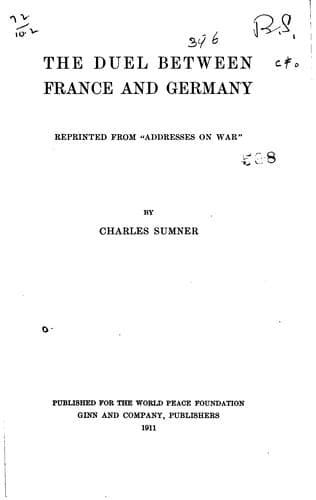
The Duel Between France and GermanySumner, Charles
History
The Duel Between France and Germany
Sumner, Charles
Franco-Prussian War, 1870-1871
let me say, expected it for no better reason than that of his
royal predecessor, stimulated by an unprincipled Minister anxious
for personal position. The parallel is continued in the curse
which the Imperial arms have brought on France.
PROGRESS OF THE WAR.
How this war proceeded I need not recount. You have all read the
record day by day, sorrowing for Humanity,--how, after briefest
interval of preparation or hesitation, the two combatants first
crossed swords at Saarbruecken, within the German frontier, and the
young Prince Imperial performed his part in picking up a bullet
from the field, which the Emperor promptly reported by telegraph
to the Empress,--how this little military success is all that was
vouchsafed to the man who began the war,--how soon thereafter
victory followed, first on the hill-sides of Wissembourg and then
of Woerth, shattering the army of MacMahon, to which the Empire
was looking so confidently,--how another large army under Bazaine
was driven within the strong fortress of Metz,--how all the
fortresses, bristling with guns and frowning upon Germany, were
invested,--how battle followed battle on various fields, where
Death was the great conqueror,--how, with help of modern art, war
showed itself to be murder by machinery,--how MacMahon, gathering
together his scattered men and strengthening them with reinforcements,
attempted to relieve Bazaine,--how at last, after long marches,
his large army found itself shut up at Sedan with a tempest
of fire beating upon its huddled ranks, so that its only
safety was capitulation,--how with the capitulation of the army
was the submission of the Emperor himself, who gave his sword to
the King of Prussia and became prisoner of war,--and how, on the
reception of this news at Paris, Louis Napoleon and his dynasty
were divested of their powers and the Empire was lost in the
Republic. These things you know. I need not dwell on them. Not to
battles and their fearful vicissitudes, where all is incarnadined
with blood, must we look, but to the ideas which prevail,--as for
the measure of time we look, not to the pendulum in its
oscillations, but to the clock in the tower, whose striking tells
the hours. A great hour for Humanity sounded when the Republic was
proclaimed. And this I say, even should it fail again; for every
attempt contributes to the final triumph.
A WAR OF SURPRISES.
The war, from the pretext at its beginning to the capitulation at
Sedan, has been a succession of surprises, where the author of the
pretext was a constant sufferer. Nor is this strange. Falstaff
says, with humorous point, "See now how wit may be made a Jack-a-
lent, when't is upon ill employment!"[Footnote: Merry Wives of
Windsor, Act V. Sc. 5.]--and another character, in a play of
Beaumont and Fletcher, reveals the same evil destiny in stronger
terms, when he says,--
Public-domain text, read in full here on John Shaqi.
Reviews
Reviews
No reviews yet
Be the first to share your thoughts on this work.
Join the Discussion
Join the discussion
Sign in to leave a comment or review.
Sign InorCreate an account