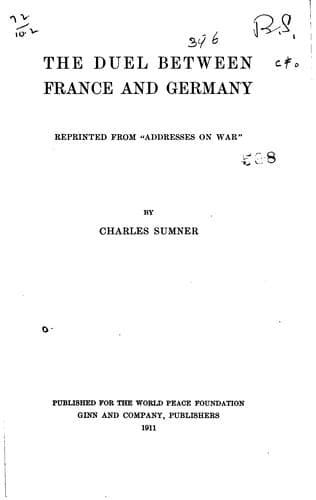
The Duel Between France and GermanySumner, Charles
History
The Duel Between France and Germany
Sumner, Charles
Franco-Prussian War, 1870-1871
The duel in its simplest form is between two individuals. In early
ages it was known sometimes as the Judicial Combat, and sometimes
as Trial by Battle. Not only points of honor, but titles to land,
grave questions of law, and even the subtilties of theology, were
referred to this arbitrament, [Footnote: Robertson, History of the
Reign of Charles V.: View of the Progress of Society in Europe,
Section I. Note XXII.]--just as now kindred issues between nations
are referred to Trial by Battle; and the early rules governing the
duel are reproduced in the Laws of War established by nations to
govern the great Trial by Battle. Ascending from the individual to
corporations, guilds, villages, towns, counties, provinces, we
find that for a long period each of these bodies exercised what
was called "the Right of War." The history of France and Germany
shows how reluctantly this mode of trial yielded to the forms of
reason and order. France, earlier than Germany, ordained "Trial by
Proofs," and eliminated the duel from judicial proceedings, this
important step being followed by the gradual amalgamation of
discordant provinces in the powerful unity of the Nation,----so
that Brittany and Normandy, Franche-Comte and Burgundy, Provence
and Dauphiny, Gascony and Languedoc, with the rest, became the
United States of France, or, if you please, France. In Germany the
change was slower; and here the duel exhibits its most curious
instances. Not only feudal chiefs, but associations of tradesmen
and of domestics sent defiance to each other, and sometimes to
whole cities, on pretences trivial as those which have been the
occasion of defiance from nation to nation. There still remain to
us Declarations of War by a Lord of Frauenstein against the free
city of Frankfort, because a young lady of the city refused to
dance with his uncle,--by the baker and domestics of the Margrave
of Baden against Esslingen, Reutlingen, and other imperial
cities,--by the baker of the Count Palatine Louis against the
cities of Augsburg, Ulm, and Rottweil,--by the shoe-blacks of the
University of Leipsic against the provost and other members,--and
by the cook of Eppstein, with his scullions, dairy-maids, and
dish-washers, against Otho, Count of Solms. [Footnote: Coxe,
History of the House of Austria. (London, 1820) Ch. XIX., Vol. I.
p. 378.] This prevalence of the duel aroused the Emperor
Maximilian, who at the Diet of Worms put forth an ordinance
abolishing the right or liberty of Private War, and instituting a
Supreme Tribunal for the determination of controversies without
appeal to the duel, and the whole long list of duellists, whether
corporate or individual, including nobles, bakers, shoe-blacks,
and cooks, was brought under its pacific rule. Unhappily the
beneficent reform stopped half-way, and here Germany was less
fortunate than France. The great provinces were left in the
enjoyment of a barbarous independence, with the "right" to fight
each other.
Public-domain text, read in full here on John Shaqi.
Reviews
Reviews
No reviews yet
Be the first to share your thoughts on this work.
Join the Discussion
Join the discussion
Sign in to leave a comment or review.
Sign InorCreate an account