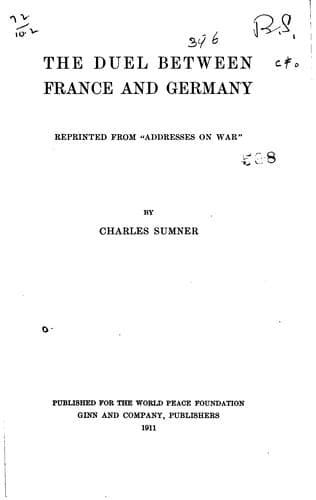
The Duel Between France and GermanySumner, Charles
History
The Duel Between France and Germany
Sumner, Charles
Franco-Prussian War, 1870-1871
3. Beyond even these considerations of economy and advantage I put
the transcendent, priceless benefit of Disarmament in the
_assurance of peace_. Disarmament substitutes the constable
for the soldier, and reduces the Standing Army to a police. The
argument assumes, first, the needlessness of a Standing Army, and,
secondly, its evil influence. Both of these points were touched at
an early day by the wise Chancellor of England, Sir Thomas More,
when, in his practical and personal Introduction to "Utopia," he
alludes to what he calls the "bad custom" of keeping many
servants, and then says: "In France there is yet a more
pestiferous sort of people; for the whole country is full of
soldiers, that are still kept up in time of peace,--if such a
state of a nation can be called a peace." Then, proceeding with
his judgment, the Chancellor holds up what he calls those
"pretended statesmen" whose maxim is that "it is necessary for the
public safety to have a good body of veteran soldiers ever in
readiness." And after saying that these pretended statesmen
"sometimes seek occasion for making war, that they may train up
their soldiers in the art of cutting throats," he adds, in words
soon to be tested, "But France has learned, to its cost, how
dangerous it is to feed such beasts." [Footnote: Utopia, tr.
Burnet, (London, 1845,) Book I. pp. 29, 30.] It will be well, if
France has learned this important lesson. The time has come to
practise it.
All history is a vain word, and all experience is at fault, if
large War Preparations, of which the Standing Army is the type,
have not been constant provocatives of war. Pretended protectors
against war, they have been real instigators to war. They have
excited the evil against which they were to guard. The habit of
wearing arms in private life exercised a kindred influence. So
long as this habit continued, society was darkened by personal
combat, street-fight, duel, and assassination. The Standing Army
is to the nation what the sword was to the modern gentleman, the
stiletto to the Italian, the knife to the Spaniard, the pistol to
our slave-master,--furnishing, like these, the means of death; and
its possessor is not slow to use it. In stating the operation of
this system we are not left to inference. As France, according to
Sir Thomas More, shows "how dangerous it is to feed such beasts,"
so does Prussia, in ever-memorable instance, which speaks now with
more than ordinary authority, show precisely how the Standing Army
may become the incentive to war. Frederick, the warrior king, is
our witness. With honesty or impudence beyond parallel, he did not
hesitate to record in his Memoirs, among the reasons for his war
upon Maria Theresa, that, on coming to the throne, he found
himself with "troops always ready to act." Voltaire, when called
to revise the royal memoirs, erased this confession, but preserved
a copy;[Footnote: Brougham, Lives of Men of Letters, (London and
Glasgow, 1856,) p. 59,--_Voltaire_.
Public-domain text, read in full here on John Shaqi.
Reviews
Reviews
No reviews yet
Be the first to share your thoughts on this work.
Join the Discussion
Join the discussion
Sign in to leave a comment or review.
Sign InorCreate an account