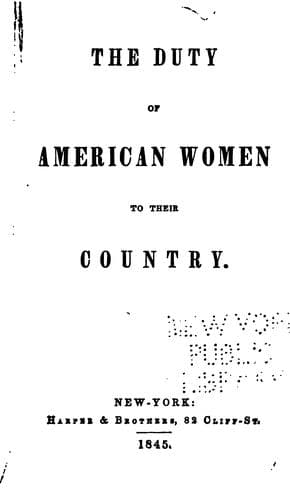
The Duty of American Women to Their CountryBeecher, Catharine Esther
History
The Duty of American Women to Their Country
Beecher, Catharine Esther
Education; Education -- United States; Women teachers -- United States
The extent of these evils may be perceived from the report, which says of
one county about as well supplied as any, out of _eighty-seven_ districts
only _twenty_ schoolhouses have provided means for keeping their wood dry.
Another says, “At the commencement of the winter term of our schools,
some one of the trustees generally furnishes a load of green wood,
perhaps his own proportion. The teacher proceeds till this is exhausted,
and he is compelled to notify his patrons of the entire destitution of
wood. After meeting his school, and shivering over expiring embers till
the hope of a supply is exhausted, he dismisses the school for one, two,
or three days, and sometimes for a week, before any inhabitant finds
time to get another load of green wood. With such wood it is impossible
to keep the schoolroom at a proper temperature. The scholars, at first,
crowd around the stove, suffering extremely with cold, and then are
driven as far off as they can get, in a high state of perspiration, and
almost suffocated with heat. Our schools in this country suffer much from
such methods of procuring fuel. The time which is lost in school hours by
the use of green wood, I think will include near one fourth of the whole
time.”
Another says, “The teacher found abundant employment in stuffing the old
stove with green birch and elm, cut as occasion required by the teacher
and the boys. A continual coughing was kept up by nearly seven-eighths
of the children, and the teacher apologised for want of order by saying,
‘they could not usually do much in stormy weather till afternoon, when
the fire would get a going.’ On this occasion, one trustee and two of the
inhabitants of the district were present an hour, when, getting frozen
out, they asked to be excused, and left the children to suffer, saying,
‘We did not think our house was so uncomfortable. Some glass must be got,
and a load of dry wood’” Some of the statements of these superintendents,
as to the order and neatness of their schoolhouses, are no less
lamentable. One remarks, that “some of them, as to neatness, resemble
the domicil for swine.” Another describes one schoolhouse as “having the
clapboards torn off, the door just ready to fall, an aperture in the roof
where the chimney once was, slabs with a pair of clubs at each end for
legs, and so high no child could touch foot to the floor, rickety desks
falling to ruin, the plaster torn off, and the whole covered with dirt,
and as filthy as the street itself.” But this is not all. “This house is
situated in a district of wealthy farmers.”
Another says, “It is a startling truth, that very many of our
schoolhouses furnish no private retreat whatever for teacher or scholar.
Thus is one side of the schoolhouse, and, in some instances, the
doorstep, rendered a scene more disgusting than the filth of a pig-sty.”
Public-domain text, read in full here on John Shaqi.
Reviews
Reviews
No reviews yet
Be the first to share your thoughts on this work.
Join the Discussion
Join the discussion
Sign in to leave a comment or review.
Sign InorCreate an account