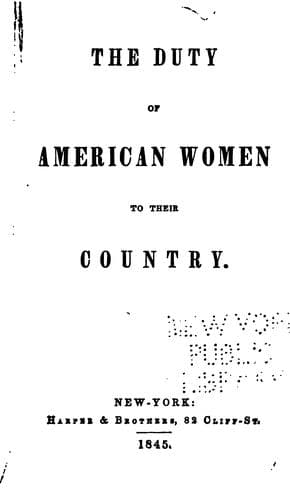
The Duty of American Women to Their CountryBeecher, Catharine Esther
History
The Duty of American Women to Their Country
Beecher, Catharine Esther
Education; Education -- United States; Women teachers -- United States
Another writes thus: “I have alluded to the representations of vulgarity
and obscenity that meet the eye in every direction. I am constrained
to add that, during intermissions, ‘certain lewd fellows of the baser
sort’ sometimes lecture boys and girls, large and small, illustrating
their subject by these vile delineations. Many of our schoolhouses are
nurseries of disorder, vulgarity, profanity, and obscenity--nay, more, in
some cases, they are the very hothouses of licentiousness.”
One single statement, made up from these reports of the county
superintendents, and presented by the head superintendent in his report,
speaks volumes on the neglect of modesty, decency, neatness, and purity.
In the whole state there are six thousand schoolhouses destitute of any
kind of woodhouse or privy; and of the whole number, only about one
thousand have privies provided with separate accommodations for children
of different sexes.
It appears, also, that though the schools and teachers are fast rising in
character, and that many now are of uncommon excellence, yet that many of
the teachers are notoriously depraved, while intellectual training, in
the majority of cases, is deplorably low, and the moral training still
more defective.
One superintendent remarks, “Gloomy, indeed, are the impressions made by
our schoolhouses. The lessons of immorality and indecency often taught
there would cause a shudder to thrill every sensitive mind.” Another
says, “There are, I regret to say, many teachers whose morals, manners,
and daily example wholly unfit them for their duties.” Another says, “In
some instances, moral qualifications have been wholly disregarded, and
teachers notoriously intemperate employed.” Says another, “I have found
a number whose language was low, obscene, and sensual, still employed in
teaching.”
Says another, “If the tastes, associations, and moral sentiments of the
teacher lack elevation and dignity, what literary progress will atone for
examples so pernicious? And yet such are the moral influences shed about
them by many licensed to teach.”
After presenting all these shocking details, the chief superintendent, in
1844, thus remarks:
Public-domain text, read in full here on John Shaqi.
Reviews
Reviews
No reviews yet
Be the first to share your thoughts on this work.
Join the Discussion
Join the discussion
Sign in to leave a comment or review.
Sign InorCreate an account