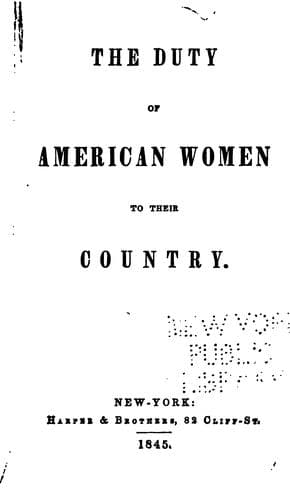
The Duty of American Women to Their CountryBeecher, Catharine Esther
History
The Duty of American Women to Their Country
Beecher, Catharine Esther
Education; Education -- United States; Women teachers -- United States
In attempting to enlist American women in the work of securing _a proper_
education to the children of this nation, there is one topic worthy of
special consideration. The great problem of the age on this subject is,
how shall the moral and religious instruction of children be secured
_at school_? When we consider the vast multitudes of children who have
no such training, either at home or anywhere else, this question becomes
one of paramount interest; for, unless virtuous and moral principles and
habits are formed, education only adds new powers of mischief to those
who are trained. The indifference of a large portion of the community
to this subject, and the extreme sensitiveness of sectarian jealousy,
interpose great obstacles; but these may be much more readily overcome
than many suppose.
Professor Stowe, in his Report to the Legislature of Ohio on the Prussian
System of Schools, makes these remarks.
“The universal success, also, and very beneficial results, with which the
arts of drawing and designing, music, and also _moral instruction and the
Bible_, have been introduced into schools, was another fact peculiarly
interesting to me.
“I asked all the teachers with whom I conversed whether they did not
sometimes find children incapable of learning to draw and to sing. I
have had but one reply, and that was, that they found the same diversity
of natural talent in regard to these as in regard to reading, writing,
and other branches of education; but they had never seen a child capable
of learning to read and write, who could not be taught to sing well and
draw neatly; and that, too, without taking any time which would interfere
with, or which would not rather promote progress in other studies.
“In regard to the necessity of moral instruction and the beneficial
influence of the Bible in schools, the testimony was no less explicit and
uniform. I inquired of all classes of teachers, and of men of every grade
of religious faith; instructers in common schools, high schools, and
schools of art; of professors in colleges, universities, and professional
seminaries in cities and in the country; in places where there was a
uniformity of creed, and in places where there was a diversity of creeds;
I inquired of believers and unbelievers, of rationalists and enthusiasts,
of Catholics and Protestants, and I never found but one reply: and that
was, that to leave the moral faculty uninstructed was to leave the most
important part of the human mind undeveloped, and to strip education of
almost everything that makes it valuable; and that the Bible is the
best book to put into the hands of children, to interest, to exercise,
and to unfold both the intellectual and moral powers. Every teacher whom
I consulted repelled with indignation the idea, that moral instruction
is not proper for schools, and that the Bible cannot be introduced into
common schools without sectarian bias in teaching.”
Public-domain text, read in full here on John Shaqi.
Reviews
Reviews
No reviews yet
Be the first to share your thoughts on this work.
Join the Discussion
Join the discussion
Sign in to leave a comment or review.
Sign InorCreate an account