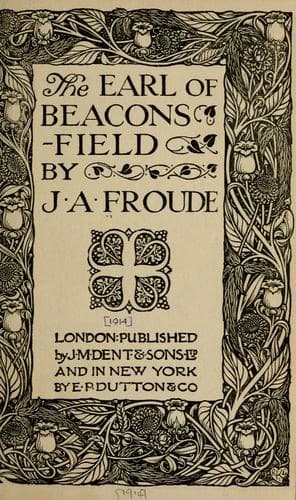
When he wrote 'Coningsby' and 'Sybil,' Disraeli regretted the
Reformation. The most ardent admirer of the Middle Ages did not regard
the overthrow of the ecclesiastical rule, and the suppression of the
religious houses, with more displeasure, or believed more devotedly in
the virtues of the abbots and the beneficent working of the monastic
system. In his 'Life of Lord George Bentinck' he had so far changed his
mind that he refuses to _Roman Catholic_ the dignity of capital letters.
Twenty additional years of experience had taught him that the modern
Roman hierarchy was as unscrupulous as the Reformers had described their
predecessors, and that, of the many dangers which threatened England,
there was none more insidious than the intrigues of ultramontane
proselytisers.
The battle of Mentana follows, and Garibaldi's defeat by the French.
Lothair is shot down at the General's side, and is left for dead on the
field. Being found breathing, he is taken up with the other wounded. His
English Catholic friends are in Rome for the winter, and devote
themselves to the care of the hospitals. An Italian woman brings word to
Miss Arundel that one of her countrymen is lying at the point of death,
who may be recovered if she takes charge of him. He is found to be
Lothair, and the opportunity is seized for a thaumaturgical performance
as remarkable as the miracle-working at Lourdes. The woman who brought
the account is discovered, by a halo round her head, to have been the
Virgin in person; Lothair, unknown to himself, to have fallen not as a
Garibaldian but as a volunteer in the Papal army. He is carried,
unconscious, to the enchanter's cave, in the shape of a room in the
Agostini Palace. He is watched over while in danger by a beautiful
veiled figure. He is surrounded in convalescence by adroit Monsignori,
and prevailed on to assist in a ceremony which is represented to him as
a mere thanksgiving for his recovery, but in which he finds himself
walking first in a procession, candle in hand, at Miss Arundel's side,
she and he the special objects of the Virgin's care. The next morning
the whole performance is published in full in the 'Papal Gazette,' and
his Cardinal guardian then appears on the stage, to tell him that he is
'the most favoured of men,' and that the Holy Father in person will
immediately receive him into the Church.
Too weak from illness to express his indignation in more than words, he
protests against the insolent deceit. Nowhere in English fiction is
there any passage where the satire is more delicate than in the
Cardinal's rejoinder. Lothair opens a window into Disraeli's mind,
revealing the inner workings of it more completely than anything else
which he wrote or said. For this reason I have given so many pages to
the analysis of it, and must give one or two more.
Public-domain text, read in full here on John Shaqi.
Reviews
Reviews
No reviews yet
Be the first to share your thoughts on this work.
Elsewhere in the archive
Join the Discussion
Join the discussion
Sign in to leave a comment or review.
Sign InorCreate an account