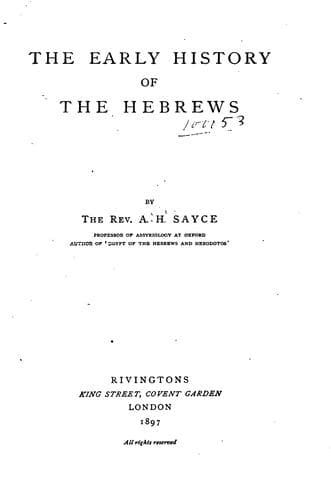
The early history of the HebrewsSayce, A. H. (Archibald Henry)
History
The early history of the Hebrews
Sayce, A. H. (Archibald Henry)
Bible. Old Testament -- Criticism, interpretation, etc.; Jews -- History -- To 953 B.C.
Evidence is accumulating that the same literary culture which thus
prevailed in Egypt and Western Asia had extended also to the peninsula
of Arabia. Dr. Glaser and Professor Hommel, two of the foremost
authorities on the subject, believe that some of the inscriptions of
Southern Arabia go back to the age of the eighteenth and nineteenth
Egyptian dynasties; and if they are right, as they seem to be, in
holding that the kingdom of Ma’n or the Minæans preceded that of Saba or
Sheba, the antiquity of writing in Arabia must be great.[133] The fact
that the Babylonian dynasty to which Amraphel belonged was of South
Arabian origin supports the belief in the existence of Arabian culture
at an early period, as do also the latest researches into the source of
the so-called Phœnician alphabet. We now know that in the Mosaic age it
was the cuneiform syllabary, and not the Phœnician alphabet, that was
used in Canaan, while the oldest inscription in Phœnician letters yet
found is later than the reign of Solomon. On the other hand, the South
Arabian form of the alphabet contains letters which denote sounds once
possessed by all the Semitic languages, but lost by the language of
Canaan; and though some of these letters may be derived from other
letters of the alphabet, there are some which have an independent
origin. The caravan-road along which the spices of the South were
carried to Syria and Egypt passed through the territory of Edom;
inscriptions of the kings of Ma’n have already been discovered near
Teima, not far from the frontiers of Midian; and it may be that we shall
yet find records among the ranges of Mount Seir which will form a link
between the early texts of Southern Arabia and the oldest text that has
come from Phœnician soil.
The Exodus from Egypt, then, took place during a highly literary period,
and the people who took part in it passed from a country where the art
of writing literally stared them in the face to another country which
had been the centre of the Tel el-Amarna correspondence and the home of
Babylonian literary culture for unnumbered centuries. Is it conceivable
that their leader and reputed lawgiver should not have been able to
write, that he should not have been educated ‘in the wisdom of Egypt,’
or that the upper classes of his nation should not have been able to
read? Let it be granted that the Israelites were but a Bedâwin tribe
which had been reduced by the Pharaohs to the condition of public
slaves; still, they necessarily had leaders and overseers among them,
who, according to the State regulations of Egypt, were responsible to
the Government for the rest of their countrymen, and some at least of
these leaders and overseers would have been educated men. Moses could
have written the Pentateuch, even if he did not do so.
Public-domain text, read in full here on John Shaqi.
Reviews
Reviews
No reviews yet
Be the first to share your thoughts on this work.
Elsewhere in the archive
Join the Discussion
Join the discussion
Sign in to leave a comment or review.
Sign InorCreate an account