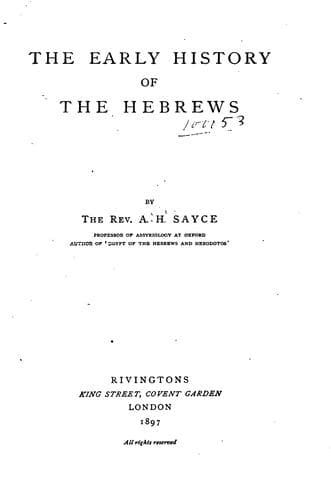
The early history of the HebrewsSayce, A. H. (Archibald Henry)
History
The early history of the Hebrews
Sayce, A. H. (Archibald Henry)
Bible. Old Testament -- Criticism, interpretation, etc.; Jews -- History -- To 953 B.C.
Moreover, the clay tablets on which the past history of Canaan could be
read were preserved in the libraries and archive-chambers of the
Canaanitish cities down to the time when the latter were destroyed. If
any doubt had existed on the subject after the revelations of the Tel
el-Amarna tablets, it has been set at rest by the discovery of a similar
tablet on the site of Lachish. In some cases the cities were not
destroyed, so far as we know, until the period when it is allowed that
the Israelites had ceased to be illiterate. Gezer, for example, which
plays a leading part in the Tel el-Amarna correspondence, does not seem
to have fallen into the hands of an enemy until it was captured by the
Egyptian Pharaoh and handed over to his son-in-law Solomon. As long as a
knowledge of the cuneiform script continued, the early records of Canaan
were thus accessible to the historian, many of them being
contemporaneous with the events to which they referred.
A single archæological discovery has thus destroyed the base of
operations from which a one-sided criticism of Old Testament history had
started. The really strong point in favour of it was the assumption that
the Mosaic age was illiterate. Just as Wolf founded his criticism and
analysis of the Homeric Hymns on the belief that the use of writing for
literary purposes was of late date in Greece, so the belief that the
Israelites of the time of Moses could not read or write was the ultimate
foundation on which the modern theory of the composition of the
Hexateuch has been based. Whether avowed or not, it was the true
starting-point of critical scepticism, the one solid foundation on which
it seemed to rest. The destruction of the foundation endangers the
structure which has been built upon it.
In fact, it wholly alters the position of the modern critical theory.
The _onus probandi_ no longer lies on the shoulders of the defenders of
traditional views. Instead of being called upon to prove that Moses
could have written a book, it is they who have to call on the disciples
of the modern theory to show reason why he should not have done so. And
it is always difficult to prove a negative.
Public-domain text, read in full here on John Shaqi.
Reviews
Reviews
No reviews yet
Be the first to share your thoughts on this work.
Elsewhere in the archive
Join the Discussion
Join the discussion
Sign in to leave a comment or review.
Sign InorCreate an account