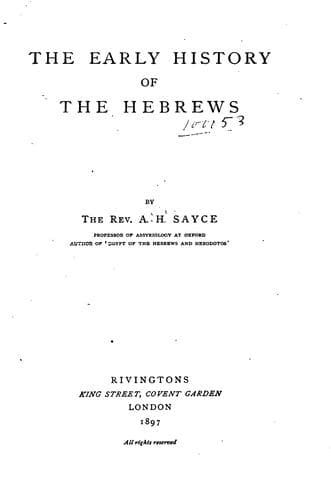
The early history of the HebrewsSayce, A. H. (Archibald Henry)
History
The early history of the Hebrews
Sayce, A. H. (Archibald Henry)
Bible. Old Testament -- Criticism, interpretation, etc.; Jews -- History -- To 953 B.C.
It may be said that the positive arguments of the modern hypothesis
remain as they were. That is possible, but their background is gone. And
how conscious the Hexateuchal analysts were of the importance of this
background, before the discovery of the Tel el-Amarna tablets, may be
seen from their desperate efforts to rid themselves of the counter
evidence afforded by the Song of Deborah. ‘Out of Machir,’ it is there
said (Judg. v. 14), ‘came down lawgivers, and out of Zebulun they that
handle the stylus of the scribe.’ In defiance of philology, the latter
words were translated ‘the baton of the marshal’! But _sopher_ is
‘scribe’ here, as elsewhere in Hebrew; and his _shebhet_, or ‘stylus,’
is often depicted on the Egyptian monuments. In the Blessing of Jacob,
which is allowed to be of early date, like the Song of Deborah, the
_shebhet_ is associated with the _m’khoqêq_ or ‘lawgiver’ (Gen. xlix.
10). The word _m’khoqêq_, however, meant literally an ‘engraver,’ one
who did not write his laws on papyrus or parchment, as the scribe would
have done, but caused them to be engraved on stone, or metal, or
clay.[134] In either case they were written down; and written documents
are thus implied not only in the expression ‘the stylus of the scribe,’
but in the word ‘lawgiver’ as well. The Song of Deborah, by general
consent, belongs to the oldest period of the Hebrew settlement in
Palestine; it belongs also to an age of anarchy and national depression;
and, nevertheless, it is already acquainted with Israelitish lawgivers
and scribes, with engravers of the laws and handlers of the pen. It is
little wonder that its evidence was explained away in accordance with a
method which is neither scientific nor historical.
As historians, we are bound to admit the antiquity of writing in Israel.
The scribe goes back to the Mosaic age, like the lawgiver, and in this
respect, therefore, the Israelites formed no exception to the nations
among whom they lived. They were no islet of illiterate barbarism in the
midst of a great sea of literary culture and activity, nor were they
obstinately asleep while all about them were writing and reading.
But even the analysis of the Hexateuchal critics fails to stand the test
of archæological discovery. Nowhere does there seem to be clearer
evidence of the documentary hypothesis than in the story of the Deluge.
Here the combination of a Yahvistic and an Elohistic narrative seems to
force itself upon the attention of the reader, and the advocates of the
disintegration theory have triumphantly pointed to the internal
contradictions and inconsistencies of the story in support of their
views. If anywhere, here, at any rate, the external testimony of
archæeology ought to be given on the side of modern criticism.
Public-domain text, read in full here on John Shaqi.
Reviews
Reviews
No reviews yet
Be the first to share your thoughts on this work.
Elsewhere in the archive
Join the Discussion
Join the discussion
Sign in to leave a comment or review.
Sign InorCreate an account