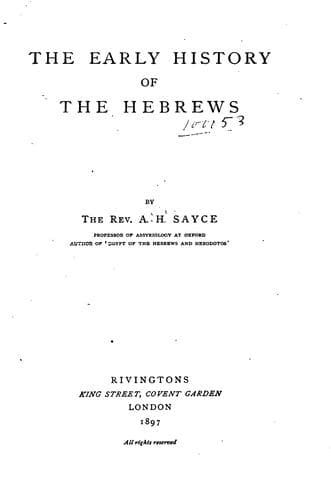
The early history of the HebrewsSayce, A. H. (Archibald Henry)
History
The early history of the Hebrews
Sayce, A. H. (Archibald Henry)
Bible. Old Testament -- Criticism, interpretation, etc.; Jews -- History -- To 953 B.C.
The name ‘Hebrew’ comes from a root which means ‘to pass’ or ‘cross
over.’ It has been variously explained as ‘a pilgrim,’ ‘a dweller on the
other side,’ ‘a crosser of the river.’ But the second explanation is
that which best harmonises with philological probabilities. We find
other derivatives from the same root. Among them is Abarim, the name of
that mountain-range of Moab on ‘the other side’ of the Jordan, from
whence Moses beheld the Promised Land (Numb. xxvii. 12), as well as
Ebronah, near the Gulf of Aqaba, one of the resting-places of the
children of Israel (Numb. xxxiii. 34). Hebrew genealogists indeed seem
to have connected the name with that of the patriarch Eber. But this is
in accordance with that spirit of Semitic idiom which throws geography
and ethnology into a genealogical form. It is probable that the name of
the patriarch is merely the Babylonian _ebar_, ‘a priest,’ which is met
with in Babylonian contracts of the age of Abraham.
Professor Hommel, however, supplementing a suggestion of Dr. Glaser, has
recently drawn attention to certain facts which throw light on the early
use of the name ‘Hebrew,’ even if they do not remove all the
difficulties connected with it.[8] A Minæan inscription from the south
of Arabia, in which the name of ’Ammi-zadoq occurs, couples together the
countries of Misr or Egypt, of Aashur, the Ashshurim of Gen. xxv. 3, and
of ’Ibr Naharân, ‘the land beyond the river.’ In another Minæan
inscription of the same age, the name of ’Ibr Naharân is replaced by
that of Gaza. It is clear, therefore, that in ’Ibr Naharân we must see
the south of Palestine. But the Minæan texts are not alone in their use
of the term. A broken Assyrian tablet from the library of Nineveh[9]
also refers to Ebir-nâri, ‘the land beyond the river,’ in Canaan, and
associates it with Beth-el, Tyre, and Jeshimon. Professor Hommel is
probably right in assigning the inscription to the reign of
Assur-bel-Kala, the son of Tiglath-pileser I. (B.C. 1080). At all
events, the name seems to be of Babylonian origin, like most of the
geographical expressions adopted by the Assyrians, and it is
consequently very possible that Ebir-nâri primarily signified the
country on the western bank of the Euphrates, where Ur was situated, and
that it was subsequently extended to the country west of the Jordan when
Syria became a province of the Babylonian empire.[10]
Public-domain text, read in full here on John Shaqi.
Reviews
Reviews
No reviews yet
Be the first to share your thoughts on this work.
Join the Discussion
Join the discussion
Sign in to leave a comment or review.
Sign InorCreate an account