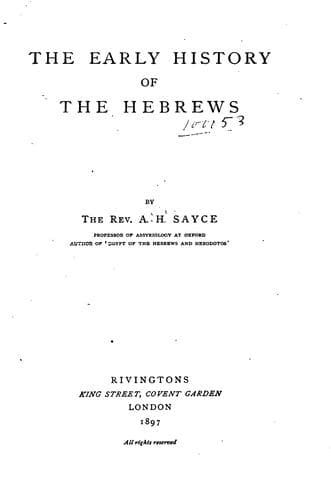
The early history of the HebrewsSayce, A. H. (Archibald Henry)
History
The early history of the Hebrews
Sayce, A. H. (Archibald Henry)
Bible. Old Testament -- Criticism, interpretation, etc.; Jews -- History -- To 953 B.C.
See Bissell, Introduction to _Genesis printed in Colours_ (1892), pp.
xi-xiii; also p. vii, where he says: ‘The argument from language
outside the divine names requires extreme care for obvious reasons. It
is admitted to be relatively weak, and can never have more than a
subordinate and supplementary value. There is no visible cleavage line
among the supposed sources.’ Professor Bissell’s work is an attempt to
represent by different colours the text of Genesis as it has been
analysed and disintegrated by the ‘higher critics,’ and the result at
which he arrives in his Introduction is that the analytical theory is
a house built upon sand. As regards the account of the Flood, in which
‘it is claimed’ that two distinct narratives can be distinguished from
each other, he remarks: ‘Two flood-stories, originating, according to
the theory, hundreds of years apart, and literally swarming with
differences and contradictions ... are found to fit one another like
so many serrated blocks, and to form, united, a consecutive history
whose unity, with constant use for millenniums, has been undisputed
till our day. Is this coincidence, or is it miracle? But let us take a
closer look. We shall find no loosely joined, independent sections,
but mutually dependent parts of one whole. An occasional overlapping
of ideas, a repetition for emphasis, or enlargement, in complete
harmony with Hebrew style, there undoubtedly is. But there is also a
marked interdependence and sequence of thought wholly inconsistent
with the theory proposed. Let the reader test what J’s story would be
alone. Beginning it has none; no preliminary announcement of the
catastrophe; no command to make preparations; no report of Noah’s
attitude.... And so P’s story, taken by itself, would be equally
incomplete.... As to the alleged discrepancies in other respects, they
appear, as we have seen, to be true in other cases, only after the
text is rent asunder. The lighting system of the one does not exclude
the one window of the other; nor the covering for the roof, the door
in the side. Without the door, for which one document alone is
responsible, how is it supposed that the occupants of the ark got in
and out of it? If objects are thrown out of their due perspective, as
in a mirage, it need surprise no one if they appear distorted and
grotesque.... It is particularly in the matter of language and style
that resort is taken to this illogical and dangerous means of
text-mutilation. There are certain stylistic peculiarities of one or
the other document, it is claimed, which are fixed from the usage of
previous chapters. But unfortunately for the scheme, they appear not
unfrequently in the wrong place. For instance, the expression “male
and female” is held to be characteristic of P, J using another for it.
In vii. 3, 9, J uses this expression twice, and our critics must make
the redactor deny it.
Public-domain text, read in full here on John Shaqi.
Reviews
Reviews
No reviews yet
Be the first to share your thoughts on this work.
Elsewhere in the archive
Join the Discussion
Join the discussion
Sign in to leave a comment or review.
Sign InorCreate an account