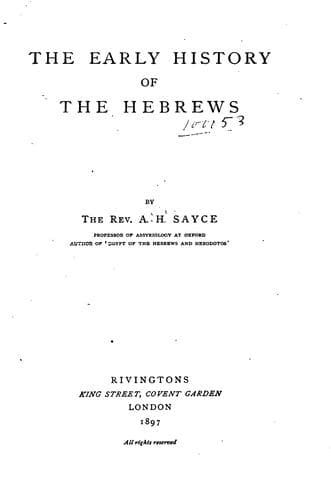
The early history of the HebrewsSayce, A. H. (Archibald Henry)
History
The early history of the Hebrews
Sayce, A. H. (Archibald Henry)
Bible. Old Testament -- Criticism, interpretation, etc.; Jews -- History -- To 953 B.C.
Moses was met by Aaron ‘in the Mount of God,’ and the two brothers
returned to Egypt together, determined to deliver Israel from its
bondage, and to lead it to that sacred mountain whereon the name of its
national God had been revealed. Unlike Sinuhit, Moses took with him his
Midianitish wife and the children she had borne him. At this point in
the narrative there has been inserted the fragment of a story which
harmonises but ill with it, or with the general spirit of Old Testament
history. The anthropomorphising legend that ‘the Lord’ met Moses and
would have killed him had not Zipporah appeased the wrathful Deity by
circumcising her son, belongs to the folklore of a people still in a
state of crude barbarism, and is part of a story which enforced the
necessity of circumcision among the Hebrew worshippers of Yahveh. An
over-minute criticism might find a contradiction between the statement
that Zipporah had but one son to circumcise, and the fact that it was
the ‘sons’ of Moses who accompanied him to Egypt (Exod. iv. 20). Such
verbal criticism, however, is needless; it is sufficient for the
historian that the story is a mere fragment, almost unintelligible as it
stands, and in complete disaccord with the historical setting in which
it is placed.
Moses and Aaron made their way to the court of the Pharaoh, and there
requested that the Israelites might be allowed to journey three days
into the desert, and hold a feast to their God. The gods of the Asiatic
nomads on the outskirts of the Delta were gods of the wilderness, whom
the Egyptians identified with Set, the enemy of Horus, the deity of the
cultivated land.[166] The Pharaoh refused the request. Once lost in the
desert, the royal slaves would be lost for ever, and would never turn
back to the line of fortifications which guarded the eastern frontier of
Egypt, and, at the same time, prevented the escape of those who dwelt
within them. The God of the Hebrews was no god whom the Pharaoh—himself
the offspring and incarnation of the Sun-god—could recognise; they were
the servants of the Egyptian king, and of none else.
Public-domain text, read in full here on John Shaqi.
Reviews
Reviews
No reviews yet
Be the first to share your thoughts on this work.
Elsewhere in the archive
Join the Discussion
Join the discussion
Sign in to leave a comment or review.
Sign InorCreate an account