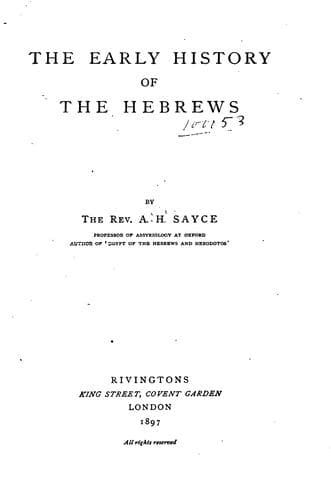
The early history of the HebrewsSayce, A. H. (Archibald Henry)
History
The early history of the Hebrews
Sayce, A. H. (Archibald Henry)
Bible. Old Testament -- Criticism, interpretation, etc.; Jews -- History -- To 953 B.C.
Those who have had experience of the flies of Egypt can sympathise with
the Pharaoh when he hastily summoned the leaders of Israel and bade them
offer sacrifice to the God who had thus shown himself a veritable ‘Lord
of Flies.’ The plague which followed—the murrain upon the cattle[171]—is
of rarer occurrence, though from time to time it still decimates the
cattle and horses of Egypt. A strict quarantine upon animals, however,
is now enforced at the Asiatic frontier, and some years, therefore, have
elapsed since the last outbreak of the cattle-plague. But the plague of
boils and blains is still endemic, and residents in the country seldom
wholly escape it. The plague of the thunder and hail is also not
unfrequent; as recently as the spring of 1895 a violent storm of the
kind swept along the valley of the Nile and destroyed three thousand
acres of cultivated land. The locusts, too, now and again, are carried
by the south-east wind from the shores of the Red Sea to devour the
rising crops, while the darkness that might be felt was but a heightened
form of the darkness occasioned by the _khamasin_ winds and sand-storms
of the spring. Even the death of the firstborn has its parallel in the
epidemic of cholera. In the space of a single year (1895-1896) the Egypt
of our own days has experienced most of the plagues of which we read in
the book of Exodus. Blood-red water, frogs and lice, flies and boils,
hailstorms and darkness, the scourge of cholera, have all visited the
land.
There was nothing, consequently, in the plagues themselves that was
either supernatural or contra-natural. They were all characteristic of
Egypt, and of Egypt alone. They were signs and wonders, not because they
introduced new and unknown forces into the life of the Egyptians, but
because the diseases and plagues already known to the country were
intensified in action and crowded into a short space of time. The
magicians beheld in them ‘the finger’ of the God of the Hebrews, since
they came and went at the command of the Hebrew leader, and all the
magic of Egypt was powerless before them. Amon-Ra had found a mightier
than himself; and the books of Thoth contained no spells or mystical
incantations which could avail against the scourges that afflicted
priest and layman alike. The reluctant Pharaoh could no longer resist
the cries of his people. Egypt was perishing, and his own son had died
of the plague. It was better that his cities should remain unfinished
than that there should be none to fill them when they were built. In the
plagues that had descended on them, his subjects saw the hand of the
wrathful Hebrew Deity, eager for the sacrifices which His people had
been prevented from offering to Him in the desert, and the sceptical
Pharaoh himself at last became a convert to their belief. In fear lest a
worse evil might befall him, he gave the order that the Israelites
should be allowed to pass the fortresses that separated Goshen from the
Public-domain text, read in full here on John Shaqi.
Reviews
Reviews
No reviews yet
Be the first to share your thoughts on this work.
Elsewhere in the archive
Join the Discussion
Join the discussion
Sign in to leave a comment or review.
Sign InorCreate an account