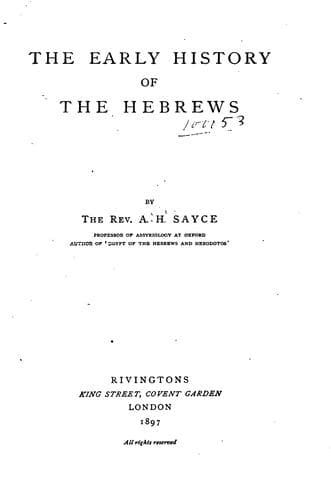
The early history of the HebrewsSayce, A. H. (Archibald Henry)
History
The early history of the Hebrews
Sayce, A. H. (Archibald Henry)
Bible. Old Testament -- Criticism, interpretation, etc.; Jews -- History -- To 953 B.C.
The runaway slaves must have taken the same road as that which had been
taken by the Israelites before them. The Israelites had avoided the
nearest and more usual road to Palestine, which ran along the edge of
the Mediterranean and passed through Gaza. The Philistines were already
threatening the southern coast of Canaan, and Gaza was garrisoned by
Egyptian troops. The undisciplined and unwarlike multitude which
followed Moses would have been cut to pieces had they ventured to force
their way through them, or else would have returned to Egypt. They
turned therefore southward towards the desert and ‘the way of the
wilderness of the Yâm Sûph.’
From Succoth, we are told, they marched to Etham ‘in the edge of the
wilderness.’ Brugsch was the first to see that in Etham we have a Hebrew
transcription of the Egyptian Khetem. The only question is, which of the
many Khetemu or ‘Fortresses’ which protected the Asiatic frontier of
Egypt this particular Etham may have been. We hear of ‘the Khetem of
Ramses II., which is in the district of Zaru,’ at the very point where
one of the roads to Asia passed through the great line of fortification,
and the report quoted above tells us of another Khetem, that of Thukut.
It was, however, the second Khetem mentioned in the report which is
referred to in the Old Testament narrative. This second Khetem lay
between Succoth and the lines of fortification, and might therefore be
described as ‘in the edge of the wilderness,’ which began on the eastern
side of the Shur or fortified wall. It was, in fact, the fortress which
guarded one of the roads out of Egypt at the point where it intersected
the lines. To the south of it came the Migdol or Tower of King Meneptah.
It is possible that this may be the Migdol which is stated in the book
of Exodus to have been near the next camping-place of the Israelites.
From the fortress of Etham they had turned to the ‘sea,’ and had there
pitched their tents ‘before Pi-hahiroth, between Migdol and the sea,
over against Baal-zephon.’ In Baal-zephon, ‘Baal of the North,’ we have
the name of a Phœnician temple, which is alluded to in an Egyptian
papyrus;[182] and in place of Pi-hahiroth, the Septuagint and Coptic
versions read ‘the farmstead,’ reminding us of the _ahu_ or ‘estate’ of
Pharaoh in the district of Thukut, on which the Edomite herdsmen were
afterwards allowed to settle.
Public-domain text, read in full here on John Shaqi.
Reviews
Reviews
No reviews yet
Be the first to share your thoughts on this work.
Elsewhere in the archive
Join the Discussion
Join the discussion
Sign in to leave a comment or review.
Sign InorCreate an account