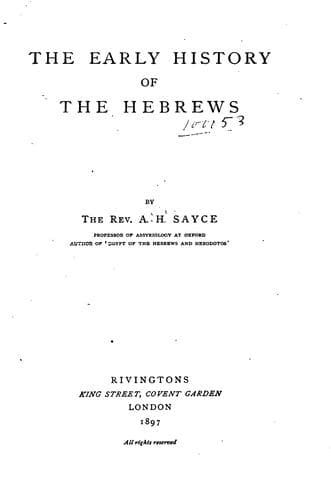
The early history of the HebrewsSayce, A. H. (Archibald Henry)
History
The early history of the Hebrews
Sayce, A. H. (Archibald Henry)
Bible. Old Testament -- Criticism, interpretation, etc.; Jews -- History -- To 953 B.C.
The work of Moses was completed. He had led Israel from the house of
bondage, had given it laws and made it a nation in the wilderness, and
had fitted it for the conquest of Canaan. The land flowing with milk and
honey, which the Semitic settlers in Egypt seem always to have regarded
as a home of refuge to which they should ultimately return, was now
within their grasp. Egyptian troops no longer garrisoned it, and its
population was weakened by intestine troubles, by the long war between
Egypt and the Hittites, and, above all, by the invasion of the
Philistines and other pirates from the Greek seas. A large portion of
the cultivated territory on the east side of the Jordan was already in
Israelite hands; all that was needed was to cross the river and take
possession of ‘the land of promise.’ Israel never forgot that it was
from hence that its ancestors had come, and tradition recorded that the
bodies of the patriarchs still lay in the rock-tomb of Machpelah. Even
now the tribes of Ephraim and Manasseh carried with them the mummy of
Joseph, from whom they claimed their origin, ready to deposit it
wherever they could gain a permanent foothold and build for themselves a
central sanctuary.
The scene of the last legislation of Moses is laid in the plains of
Moab, in the newly-won territory of Israel, and almost within sight of
the mountains of Canaan. The additional laws and regulations which
needed to be made were not many. Reuben and Gad were settled in the
districts which subsequently bore their names, the Reubenites pasturing
their flocks like nomad Bedâwin among the northern wadis of Moab, while
Gad occupied the greater portion of the Amorite kingdom of Sihon. Part
of the tribe of Manasseh also made its home in the districts of Gilead
and Bashan, which it had won by the sword.
The institution of the six cities of refuge, moreover, as well as of the
forty-eight cities of the Levites, is assigned to the same period.
Modern criticism, however, has shown itself unwilling to accept its
Mosaic authorship. But sacred cities, to which the homicide could flee
for refuge, were an ancient institution in both Syria and Asia Minor. We
find them also in the region of the Hittites. Such _asyla_, as the
Greeks called them, lasted down to the classical period, and played a
considerable part in the local history of Asia Minor. Wherever we find a
Kadesh or a Hierapolis, there we may expect to find also an asylum in
which the gods and their ministers would protect the unintentional
shedder of blood from the vengeance of man. It was a means of checking
the _vendetta_ or blood feud, which was in full harmony with primitive
law.[245]
Public-domain text, read in full here on John Shaqi.
Reviews
Reviews
No reviews yet
Be the first to share your thoughts on this work.
Elsewhere in the archive
Join the Discussion
Join the discussion
Sign in to leave a comment or review.
Sign InorCreate an account