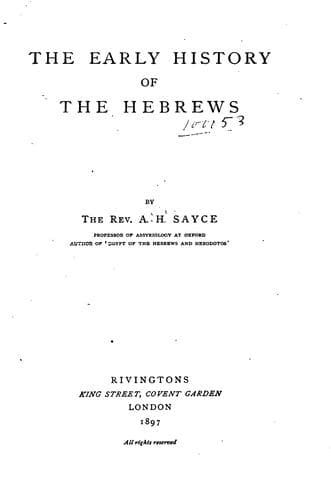
The early history of the HebrewsSayce, A. H. (Archibald Henry)
History
The early history of the Hebrews
Sayce, A. H. (Archibald Henry)
Bible. Old Testament -- Criticism, interpretation, etc.; Jews -- History -- To 953 B.C.
Thus far, it would seem, Israel and Midian had mixed together on
friendly terms. Both were desert tribes, both were connected together by
old traditions and intercourse, and claimed descent from a common
ancestor. But it was now a question of rival deities and forms of faith.
The very existence of the Law that had been promulgated from Sinai and
Kadesh was at stake; and if Israel and its religion were not to be
absorbed into the world of heathenism around them, it was time for the
tribe of Levi—the keepers of the sanctuary—to awake. Moses and Phinehas
saw the danger, and swift punishment descended on the backsliders within
Israel itself. How formidable, however, the danger had been may be
gathered from the statement that ‘all the heads of the people’ were put
to death.
The turn of Midian came next. The Midianite tribes were overthrown, and
their five shêkhs slain, one of whom, Rekem, gave his name to the city
which is better known as Petra. ‘Balaam also, the son of Beor, they slew
with the sword.’ The Midianite villages and forts were burned to the
ground, and the captives and spoil were brought to the Israelitish camp.
Here they were divided among the people, Yahveh and His priests
receiving their share. Out of a total of 16,000 captives, thirty-two
slaves were given to the Lord. Henceforth it became the rule that the
spoil taken in war should be divided into two equal parts, one-half for
the fighting men, the rest for the people as a whole; and that while the
fighting men had to deliver up only one share in five hundred to the
Levites, the priestly tribute levied on the rest of the ‘congregation’
was as much as one in fifty. The regulation was reinforced by David
after his defeat of the Amalekites when his companions clamoured for the
whole of the spoil (1 Sam. xxx. 24, 25), at all events in so far as the
equal division of it was concerned between the combatants and those who
remained at home.
The Midianites were driven from Moab and its frontiers. Their overthrow
meant the triumph of the priestly tribe in Israel. The war had been
waged not against Midian only, but against the allies and kinsmen of
Midian in Israel itself. The old relationship between Israel and Midian
had been severed on the confines of the Promised Land; the supremacy of
Yahveh in Israel had been once more asserted, and Israel had become more
than ever His peculiar people. Before they entered Canaan, it was
needful that the last links that bound them to the wild tribes of the
desert should be cut in two.
Public-domain text, read in full here on John Shaqi.
Reviews
Reviews
No reviews yet
Be the first to share your thoughts on this work.
Elsewhere in the archive
Join the Discussion
Join the discussion
Sign in to leave a comment or review.
Sign InorCreate an account