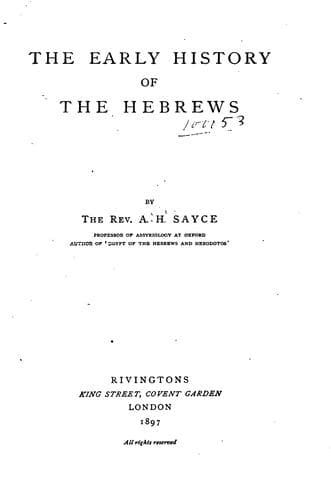
The early history of the HebrewsSayce, A. H. (Archibald Henry)
History
The early history of the Hebrews
Sayce, A. H. (Archibald Henry)
Bible. Old Testament -- Criticism, interpretation, etc.; Jews -- History -- To 953 B.C.
In the word _seneh_ a popular etymology seems to have been found for
the name of Mount Sinai. Hence it is that in Deut. xxxiii. 16, Yahveh
is described as ‘him that dwelt in the _seneh_.’ The _seneh_ was
probably the small prickly _acacia nilotica_.
Footnote 165:
No satisfactory etymology of the name Yahveh has yet been found. This,
however, is not strange, considering that the etymology was unknown to
the Hebrews themselves, as is shown by the explanation of the name in
Exod. iii. 14, where it is derived from the Aramaic _hewâ_, the Hebrew
equivalent being _hâyâh_, with _y_ instead of _w_ (or _v_). The
Babylonians were also ignorant of the original meaning of the word,
since one of the lexical cuneiform tablets gives _Yahu_ or Yahveh as
meaning ‘god’ (in Israelitish), and identifies it with the Assyrian
word _yahu_, ‘myself’ (83, 1-18, 1332 _Obv._; Col. ii. 1). No certain
traces of the name have been found except among the Israelites. It is
a verbal formation like _Jacob_, _Joseph_, etc.
Footnote 166:
Maspero, _Dawn of Civilisation_, pp. 132-134.
Footnote 167:
For ‘strikes’ among the Egyptian artisans, see Spiegelberg, _Arbeiter
und Arbeiterbewegung im Pharaonreich unter den Ramessiden_ (1895).
Footnote 168:
At Tel el-Maskhuta, or Pithom, however, the bricks were not mixed with
straw.
Footnote 169:
See Wiedemann, _Religion der alten Aegypter_, pp. 142 _sq._
Footnote 170:
Exod. vii. 19 contains an exaggeration which could easily be omitted
without any injury to the sense of the narrative. The change of water
in the river would affect the canals and such pools and ponds as were
fed from the Nile, but nothing else. The river-water is not considered
fit for drinking in the early days of the inundation. The green and
slimy vegetation brought from the Equatorial regions renders it quite
poisonous, and it is not until some days after it has become ‘red’
that it is again fit to drink.
Footnote 171:
The ‘camels’ mentioned along with the cattle in Exod. ix. 3 have been
inserted from an Israelitish point of view. The Egyptians had no
camels; and though the Bedâwin doubtless used them from an early
period, none were employed by the Egyptians themselves until the Roman
or Arab age.
Footnote 172:
Public-domain text, read in full here on John Shaqi.
Reviews
Reviews
No reviews yet
Be the first to share your thoughts on this work.
Elsewhere in the archive
Join the Discussion
Join the discussion
Sign in to leave a comment or review.
Sign InorCreate an account