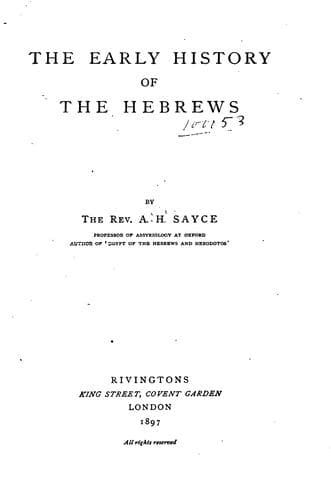
The early history of the HebrewsSayce, A. H. (Archibald Henry)
History
The early history of the Hebrews
Sayce, A. H. (Archibald Henry)
Bible. Old Testament -- Criticism, interpretation, etc.; Jews -- History -- To 953 B.C.
The passage is, unfortunately, mutilated. What remains reads thus:
‘... the tents in front of the city of Pi-Bailos, on the canal of
Shakana; ... [the adjoining land] was not cultivated, but had been
left as pasture for cattle for the sake of the foreigners. It had been
abandoned since the time of (our) ancestors. All the kings of Upper
Egypt sat within their entrenchments ... and the kings of Lower Egypt
found themselves in the midst of their cities, surrounded with
earthworks, cut off from everything by the (hostile) warriors, for
they had no mercenaries to oppose to them. Thus had it been [until
Meneptah] ascended the throne of Horus. He was crowned to preserve the
life of mankind.’ The word translated ‘tents’ is _ahilu_, the Hebrew
_ôhêl_, which is used by Ramses III. of the ‘tents’ of the Shasu or
Edomites of Mount Seir. For translations of the text, see E. de Rougé,
_Extrait d’un Mémoire sur les Attaques dirigées contre l’Égypte_, pp.
6-13 (1867); Chabas, _Recherches pour servir à l’histoire de la
^{xix}e Dynastie_, pp. 84-92 (1873); Brugsch, _Egypt under the
Pharaohs_, Eng. tr. (2nd edit.), ii. pp. 116-123; Maspero, _The
Struggle of the Nations_, pp. 433-436.
Footnote 173:
_Cont. Apion._ i. 26.
Footnote 174:
This name, however, varied in different versions of the legend.
Chærêmôn makes it Phritiphantes, which may represent Zaphnath-paaneah,
the dental (_t_) taking the place of _z_, and _pa-Ra_, ‘the sun-god’
of _pa-Ankhu_, ‘the living one.’
Footnote 175:
The papyrus is in the Hermitage at St. Petersburg (Golénischeff,
_Recueil de Travaux relatifs à la Philologie et à l’Archéologie
égyptiennes et assyriennes_, xv. pp. 88, 89).
Footnote 176:
Dr. Wilcken has pointed out (_Zur Aegyptisch-hellenistischen
Literatur_ in the _Festschrift für Georg Ebers_, 1897, pp. 146-152)
that two fragments of a Greek papyrus published by Wessely in the
_Denkschriften der Wiener Akademie_, 42, 1893, pp. 3 _sqq._, contain a
legend which closely resembles that of the Egyptian version of the
Exodus. In this, however, a potter takes the place of the seer
Amenôphis, the desire of the king to see the gods is explained by his
wish to know the future, the ‘impure people’ are called the
‘girdle-wearers,’ and the beginning of a Sothic cycle is apparently
combined with the story. Moreover, it would seem that the papyrus does
not yet know of the identification of the ‘impure people’ with the
Jews.
Footnote 177:
_The Threshold Covenant or the Beginning of Religious Rites_ (New
York, 1896).
Footnote 178:
_The Threshold Covenant_, pp. 203, 204.
Footnote 179:
See above, p. 155.
Footnote 180:
_Egypt under the Pharaohs_ (Eng. tr.), second edit., ii. pp. 96-98.
Footnote 181:
_Anastasi_, v. 19. For the translation, see Brugsch, _Egypt under the
Pharaohs_ (Eng. tr.), second edit., ii. p. 132.
Footnote 182:
First pointed out by Goodwin in the Sallier Papyrus, iv. 1, 6.
Public-domain text, read in full here on John Shaqi.
Reviews
Reviews
No reviews yet
Be the first to share your thoughts on this work.
Elsewhere in the archive
Join the Discussion
Join the discussion
Sign in to leave a comment or review.
Sign InorCreate an account