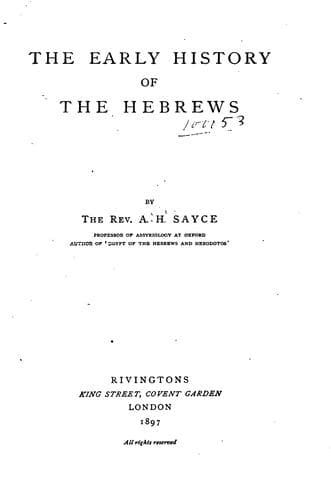
The early history of the HebrewsSayce, A. H. (Archibald Henry)
History
The early history of the Hebrews
Sayce, A. H. (Archibald Henry)
Bible. Old Testament -- Criticism, interpretation, etc.; Jews -- History -- To 953 B.C.
We can still trace the site of Jericho in the hollow of the deep valley
through which the Jordan flows into the Dead Sea. Its ruins lie round
about the ’Ain es-Sultân, a spring of warm water which gushes into an
ancient basin, overgrown with reeds and brushwood, among which the birds
flutter and watch the fish in the water below. Above towers the huge
mass of Mount Qarantel, while the black soil which forms the floor of
the hollow is covered with small artificial mounds of earth, and is
thick with the decayed relics of a tropical vegetation. In the coldest
weather it is still warm at Jericho; in summer the damp heat is
stifling, and the mosquitoes are innumerable. Now it is given over to
idle Bedâwin, but in the old days when the country was filled with an
industrious population, it was as ‘the garden of the Lord.’ No place in
Palestine was more fertile, and it commanded the ford that led across
the Jordan from the east.
The destruction of Jericho opened to Joshua the way into Canaan. Laden
with its spoil, the Israelites matched westward, up into the mountains
and through the pass of Michmash towards Beth-el. Beth-el itself was too
strong to be attacked. But a neighbouring town, whose later name of Ai,
‘the ruined heap,’ was a lasting record of its fate, was not so
fortunate. The Israelites took it by means of an ambuscade, and the same
merciless treatment was dealt out to it that had been dealt to Jericho.
The inhabitants were all massacred, ‘only the cattle and the spoil
Israel took for a prey unto themselves.’
The conquest of Ai, however, had not been easy. The Canaanites had made
a brave defence, and the invaders had at first suffered a check. The
cause was discovered in the Israelitish camp. A Jew, Achan or Achar, had
hidden under his tent some of the booty of Jericho which ought to have
been either destroyed or dedicated to Yahveh. ‘A goodly Babylonish
garment,’ two hundred shekels of silver, and a tongue-like wedge of gold
fifty shekels in weight, were the objects which he had coveted and
concealed. But the order had been issued that all objects of metal
should be given to the tabernacle, and that all things else should be
burned with fire. Achan accordingly was condemned to be stoned to death,
and along with him the rest of his family as well as his oxen, his
asses, and his sheep. Then the bodies were burnt, and a heap of stones
piled over them in memory of the event.
Public-domain text, read in full here on John Shaqi.
Reviews
Reviews
No reviews yet
Be the first to share your thoughts on this work.
Elsewhere in the archive
Join the Discussion
Join the discussion
Sign in to leave a comment or review.
Sign InorCreate an account