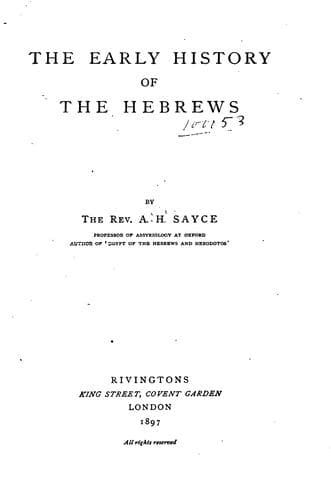
The early history of the HebrewsSayce, A. H. (Archibald Henry)
History
The early history of the Hebrews
Sayce, A. H. (Archibald Henry)
Bible. Old Testament -- Criticism, interpretation, etc.; Jews -- History -- To 953 B.C.
The mention of the ‘goodly Babylonish garment’ takes us back to the time
when Assyria had not as yet supplanted Babylonia in the west. For
centuries Babylonia had been the home of weavers and embroiderers whose
fabrics were famous all over the east. The cuneiform tablets contain
long lists of articles of clothing, each of which had its own name; and,
as we learn from the Tel el-Amarna correspondence, the merchants of
Babylonia found a ready market for their goods in the cities of Canaan.
The age of the Exodus marks the period when the old peaceful intercourse
with Babylonia was coming to an end; alien peoples had barred the road
across the Euphrates, and Babylon itself was about to fall into the
hands of an Assyrian conqueror. Henceforth it was Assyria, and not
Babylonia, whose name was known or feared in Palestine, and the writer
of a later day would have spoken of the wares of Assyria rather than
those of the Babylonians.[259]
The destruction of Ai gave Joshua a foothold in the mountain of Ephraim.
Then came the league with the Gibeonites, secured, so we are told, by
craft. Modern criticism, with needless scepticism, has seen in the
narrative merely a popular legend to account for the fact that the four
cities which formed the western half of the future territory of Benjamin
were laid under tribute, and not destroyed. But the extermination of the
Canaanites was relative, not absolute; their utter destruction, like
that of the Britons by the Saxon invaders, was the dream of a later day.
As we have seen, the Hebrew occupation of Canaan was a slow and gradual
process, and in the more important cities the older population remained
to the end. Even the temple of Solomon was built on the threshing-floor
of a Jebusite, and the heads of the prisoners which surmount the names
of the places captured by Shishak in the south of Palestine are Amorite
rather than Jewish. The Amorite population was still predominant there;
and the fellahin of to-day, as has been pointed out by M.
Clermont-Ganneau, are the lineal descendants of the old races.[260]
Gibeon, Chephirah, Beeroth, and Kirjath-jearim are not the only cities
of which we hear as having been made tributary. This was also the case
with Megiddo and Taanach, Beth-shean, Dor, and Ibleam (Judg. i. 27), as
well as with the chief cities in the territories of Zebulon and Naphtali
(Judg. i. 30, 33); while, on the other hand, the tribe of Issachar
became tributary to its Canaanitish neighbours (Gen. xlix. 15).[261] It
is more profitable to exact tribute from a wealthy and industrious
population than to exterminate it, as Mohammed found; and the near
neighbourhood of the central sanctuaries of Israel, first at Shiloh,
then at Jerusalem and Beth-el, afforded a special reason why the
Gibeonites should be made ‘hewers of wood and drawers of water for the
house of God.’
Public-domain text, read in full here on John Shaqi.
Reviews
Reviews
No reviews yet
Be the first to share your thoughts on this work.
Elsewhere in the archive
Join the Discussion
Join the discussion
Sign in to leave a comment or review.
Sign InorCreate an account