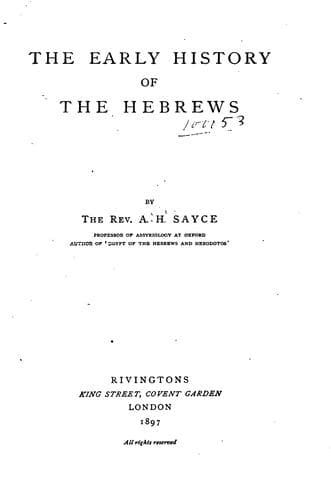
The early history of the HebrewsSayce, A. H. (Archibald Henry)
History
The early history of the Hebrews
Sayce, A. H. (Archibald Henry)
Bible. Old Testament -- Criticism, interpretation, etc.; Jews -- History -- To 953 B.C.
But all this was after Joshua had passed away. Besides crossing the
Jordan and securing a footing in Mount Ephraim, Joshua had made a
successful raid into those mountains in the ‘Negeb’ of Judah which had
been so fatal to the first Israelitish invaders of Canaan. The
destruction of Ai had excited the fears of Adoni-zedek of Jerusalem, and
in the league that had been made between Gibeon and the invaders he saw
danger to his own state. Gibeon lay only a few miles to the north of
Jerusalem, and the Tel el-Amarna tablets have shown us that the
neighbourhood of two Canaanitish cities was a quite sufficient cause of
war between them. When the tablets were written, Ebed-Tob was king of
Jerusalem, and his letters to the Pharaoh are filled with imploring
appeals for help against his enemies. These were partly the neighbouring
‘governors,’ partly the Khabiri or ‘Confederates,’ who seem to have been
of foreign origin, and who had already captured some of his cities. The
situation, therefore, was very much like what it was in the later days
of Adoni-zedek, the place of the Egyptian ‘governors’ being taken by
Gibeon, while the Khabiri were represented by the Israelites. But
Adoni-zedek had no suzerain lord in Egypt to whom he could apply for
aid. He was therefore forced to turn to the Canaanitish princes around
him and form a league with them against the invading hordes from the
desert. Hoham of Hebron, Piram of Jarmuth, Yaphia of Lachish, and Debir
of Eglon rallied to his summons, and the combined forces marched against
Gibeon and besieged the town.[262] The Gibeonites at once sent
messengers to Joshua, who accordingly left the camp at Gilgal and fell
suddenly on the besieging army. The Canaanites were utterly routed, and
fled towards Beth-horon and Makkedah, a hailstorm adding to their
discomfiture. The five kings were discovered hiding in a cave at
Makkedah, and dragged before Joshua, who pitilessly put them all to
death. The bodies were buried in the cave and great stones laid upon its
mouth, which, the compiler of the book of Joshua states, remained there
unto his day (Josh. x. 27).
The defeat of the Canaanite army was followed by the capture of Makkedah
and Libnah, which opened the road to Lachish. The site of Lachish was
rediscovered by Professor Flinders Petrie in 1890 at Tell el-Hesy,
sixteen miles eastward of Gaza. The great mound that covers its ruins
has been excavated partly by him, partly by Dr. Bliss, and the huge wall
that surrounded it in the days of the Amorites, and before which the
Israelites encamped, has been explored and measured.[263]
Public-domain text, read in full here on John Shaqi.
Reviews
Reviews
No reviews yet
Be the first to share your thoughts on this work.
Elsewhere in the archive
Join the Discussion
Join the discussion
Sign in to leave a comment or review.
Sign InorCreate an account