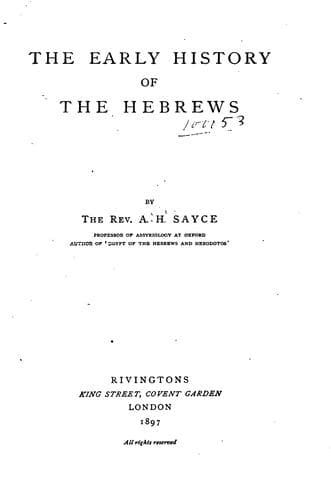
The early history of the HebrewsSayce, A. H. (Archibald Henry)
History
The early history of the Hebrews
Sayce, A. H. (Archibald Henry)
Bible. Old Testament -- Criticism, interpretation, etc.; Jews -- History -- To 953 B.C.
The city stood on a natural eminence some forty feet in height. Close to
it rises the only good spring of water in the district, which when
swollen by the winter rains becomes the torrent of the Hesy. The stream
ran past the eastern side of the city, and has eaten away part of the
remains of the successive cities which rose upon the site, one above the
ruins of the other. Fragments of the pottery used by the Amorite
defenders of the city in the days of Joshua can now be seen in the rooms
of the Palestine Exploration Fund.
The walls of Lachish, like those of the cities of Egypt, were built of
crude brick, and were nearly thirty feet in thickness. It had, in fact,
long been one of the principal fortresses of Southern Palestine. Among
the Tel el-Amarna tablets are letters from two of its governors Zimrida
and Yabniel, the first of whom was murdered, and who is mentioned on
another tablet found by Dr. Bliss among the ruins of Lachish itself. Its
capture, therefore, by the Israelites was a serious blow to the
Canaanites in the southern part of the country. But, though Horam king
of Gezer came to its assistance, all was no avail; the strong fortress
fell at last before the invaders, and ‘all the souls’ that were in it
were massacred.[264] For at least a century its site lay desolate and
uninhabited; and the explorers found in the soil that accumulated above
the ruins of the Amorite city nothing but the ashes of the camp-fires of
Bedâwin nomads.
Eglon, now probably Tell Ejlân, close to Tell el-Hesy, naturally shared
the fate of the neighbouring city. According to the compiler of the book
of Joshua, the fall of Hebron and Debir followed immediately after that
of Eglon. But this cannot be correct. Debir, as we afterwards learn, was
taken at a later date by Othniel (Josh. xv. 16, 17; Judg. i. 12, 13),
not by Joshua, and the error seems to have been due to the fact that
Debir was the name of the king of Eglon. It was the king and not the
town of that name who fell before the arms of Joshua.
Public-domain text, read in full here on John Shaqi.
Reviews
Reviews
No reviews yet
Be the first to share your thoughts on this work.
Elsewhere in the archive
Join the Discussion
Join the discussion
Sign in to leave a comment or review.
Sign InorCreate an account