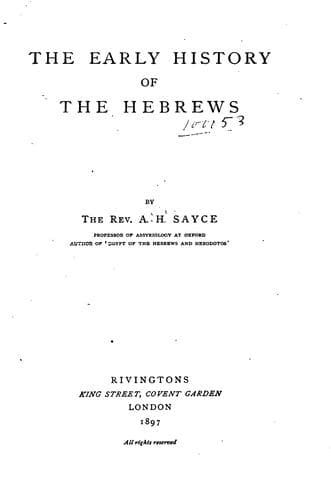
The early history of the HebrewsSayce, A. H. (Archibald Henry)
History
The early history of the Hebrews
Sayce, A. H. (Archibald Henry)
Bible. Old Testament -- Criticism, interpretation, etc.; Jews -- History -- To 953 B.C.
The life of Joshua was drawing to an end. He was an old man; it was said
he was 110 years of age at his death, the length of time the Egyptian
wished his friends to live. He had brought his people into the Promised
Land, had shown them how to take cities and defeat their adversaries,
and had planted Israel firmly in the mountainous part of Canaan. Before
his death the tribes were provisionally established in the territories
subsequently called after their names. We are not bound to believe that
the division of the land was made with the mathematical precision which
had become possible in the days of the compiler of the book of Joshua,
but to deny that it was made at all is merely an abuse of criticism. In
the period of the Judges we find most of the tribes actually settled in
the very districts which we are told were given to them, and the fact
that in one or two instances—Dan and Simeon, for example—the tribe never
gained possession of the larger part of the territory said to have been
assigned to it, shows that the story of the division could not have been
based on the later geographical position of the tribes. The doctrine of
development may have no limitations in the domain of organic nature, but
history has to take account of individual action and the arbitrary
enactments of great men. To suppose that the tribal division of
Palestine was the result of a process of development has little in
support of it, and fails to explain the geographical position
traditionally assigned to a tribe like Dan.
There was one tribe, however, to whose history the theory of development
is to some extent applicable. This was the tribe of Judah. The tribe was
only partly of Israelitish descent. Its most important family, that of
Caleb and Othniel, belonged to the Edomite tribe of Kenaz; while another
Edomite tribe, that of Jerahmeel, occupied the southern part of the
Jewish territory (1 Chron. ii. 25-33, 42). Even ‘the families of the
scribes which dwelt at Jabez’ were Kenites from Midian (1 Chron. ii.
55).[271] Down to the time of the kings the Israelitish members of the
tribe of Judah mixed freely with their neighbours; David himself was
descended from Ruth the Moabitess, and Bath-sheba, the mother of his
successor, had been the wife of a Hittite. As has been already noticed,
the prisoners whose figures surmount the names of Shishak’s conquests in
Judah have the features of the Amorite and not of the Jew. In the Song
of Deborah the tribe of Judah, like those of Dan and Simeon, is unknown.
It is Ephraim and Benjamin who form the Israelitish vanguard against the
Amalekites of the southern desert. And the deliverers of southern Israel
from its two first oppressors were Othniel the Kenizzite and Ehud the
Benjamite.
Public-domain text, read in full here on John Shaqi.
Reviews
Reviews
No reviews yet
Be the first to share your thoughts on this work.
Elsewhere in the archive
Join the Discussion
Join the discussion
Sign in to leave a comment or review.
Sign InorCreate an account