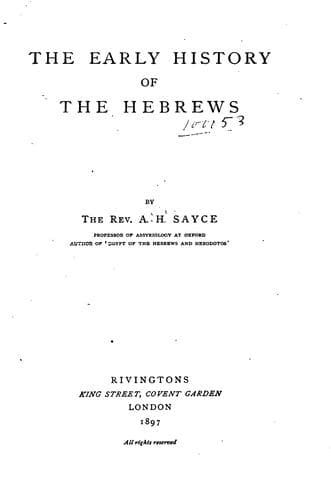
The early history of the HebrewsSayce, A. H. (Archibald Henry)
History
The early history of the Hebrews
Sayce, A. H. (Archibald Henry)
Bible. Old Testament -- Criticism, interpretation, etc.; Jews -- History -- To 953 B.C.
Joshua was buried at Timnath-serah or Timnath-heres[278] in Mount
Ephraim, in a piece of ground which had become the property of himself
and his family. The Israelites of a later day looked back upon his
memory with gratitude and veneration; he had been the hero who had
succeeded in doing what Moses had failed to accomplish, and had led his
people into the Promised Land. But history judges somewhat differently.
He was not a lawgiver or a leader of men like Moses, and even from a
military point of view the conquest of the Amorite kingdoms of Sihon and
Og was a greater achievement than securing a foothold in the mountains
of central Palestine. Joshua was not the conqueror of Canaan, as the
pious imagination of a later age supposed him to be: he merely opened
the way to it. He taught the Israelites how to defeat the Canaanites,
and he succeeded in destroying a few of their cities. But that was all;
and the wholesale massacres which marked his progress, the wanton
destruction of everything which could not be carried away as spoil, and
the barbaric extermination of the elements of culture, find their match
only in the sanguinary campaigns of some of the Assyrian kings and the
Saxon invasion of Britain.
Footnote 255:
This passage must have been written at a time when Judah had not yet
come to occupy a definite place among the tribes in Canaan, and when,
as in the Song of Deborah, the territory of Benjamin was regarded as a
sort of appendage of that of Ephraim, and as extending as far south as
the desert of the Amalekites. (See also Josh. xv. 63.)
Footnote 256:
Josh. xviii. 22.
Footnote 257:
Colonel Watson in the _Quarterly Statement_ of the Palestine
Exploration Fund, July 1895, pp. 253-261; see also Quatremère,
_Histoire des Sultans Mamluks_, ii. p. 26; and Mr. Stevenson in the
_Quarterly Statement_ October 1895, pp. 334-338.
Footnote 258:
The play is on the verb _gâlal_, ‘to roll.’ Gilgal, however, means the
‘circle’ of stones, or ‘cairn.’ Moreover, the Egyptians were
circumcised, so that uncircumcision could not correctly be called ‘the
reproach of Egypt.’ Some of the Israelites may have been circumcised
at Gilgal, but it is incredible that none of the males born in the
desert had been so. This would have been a flagrant violation of the
Mosaic law (see Lev. xii. 3; Gen. xvii. 14).
Footnote 259:
The tongue-like wedge of gold finds its parallel in six tongue-like
wedges of silver discovered by Dr. Schliemann in the ‘Third
prehistoric City’ of Hissarlik or Troy, and figured by him in _Ilios_,
pp. 470-472. Mr. Barclay V. Head has shown that they each represent
the third of a Babylonian maneh.
Footnote 260:
See my _Races of the Old Testament_, pp. 75-77; _Quarterly Statement_
of the Palestine Exploration Fund, July 1876 and July 1877.
Footnote 261:
Gezer was similarly laid under tribute by Ephraim (Josh. xvi. 10).
Footnote 262:
Public-domain text, read in full here on John Shaqi.
Reviews
Reviews
No reviews yet
Be the first to share your thoughts on this work.
Elsewhere in the archive
Join the Discussion
Join the discussion
Sign in to leave a comment or review.
Sign InorCreate an account