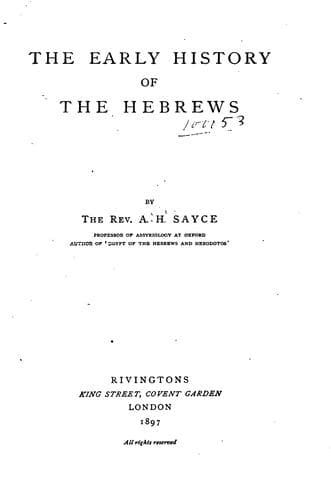
The early history of the HebrewsSayce, A. H. (Archibald Henry)
History
The early history of the Hebrews
Sayce, A. H. (Archibald Henry)
Bible. Old Testament -- Criticism, interpretation, etc.; Jews -- History -- To 953 B.C.
The Septuagint has Elam instead of Hoham, from which we may perhaps
infer that the older reading of the Hebrew text was Yeho-ham. If so,
we should have an example of the use of the name of the national God
of Israel among the Hebronites. The substitution of El for Yeho would
be parallel to the fact that in the inscriptions of the Assyrian king
Sargon the contemporary king of Hamath is called both Yahu-bihdi and
Ilu-bihdi. Cf. also Joram and Hado-ram (2 Sam. viii. 10; 1 Chron.
xviii. 10). Piram resembles the Egyptian Pi-Romi; the name was also
Karian (Sayce, _The Karian Language and Inscriptions_ in the
_Transactions of the Society of Biblical Archaeology_, ix. 1, No. ii.
3). The Jarmuth of which Piram was king cannot be the same as the
Yarimuta of the Tel el-Amarna tablets, as that seems to have been in
the north, though Karl Niebuhr makes it the Delta. For Piram the
Septuagint has Phidôn; and it changes Yaphia into Jephthah and Eglon
into Adullam.
Footnote 263:
See Flinders Petrie, _Tell el-Hesy (Lachish)_ (1891) and Bliss, _A
Mound of Many Cities_.
Footnote 264:
For Horam the Septuagint again has Elam. Perhaps the original reading
was Yehoram. There is no ground for supposing that Hoham of Hebron and
Horam of Gezer are one and the same.
Footnote 265:
It is called Huzar in the list of the conquests of Thothmes III. at
Karnak, where it follows Liusa or Laish, and precedes Pahil,
identified with Pella by Mr. Tomkins, and Kinnertu or Chinnereth.
Footnote 266:
_Records of the Past_, new ser., v. p. 89.
Footnote 267:
_Records of the Past_, new ser., v. p. 44, No. 18.
Footnote 268:
See also Josh. xi. 2.
Footnote 269:
Josh. xii. 21-24. Probably the kings of Tappuah, Hepher, Aphek, and
Sharon are to be included in the confederacy (verses 17, 18). We do
not know where Tappuah was (though it is usually placed in the Wadi
el-Afranj; G. A. Smith, _Hist. Geog. of the Holy Land_, p. 202).
Hepher can hardly be the southern Hepher referred to in 1 Kings iv.
10, but is probably Gath-Hepher west of the Sea of Galilee. Aphek (1
Sam. xxix. 1) was a few miles to the south of it, and the plain of
Sharon began at Dor. Cf., however, Beth-Tappuah (in the Wadi
el-Afranj) and Aphekah near Hebron, in Judah (Josh. xv. 53).
Footnote 270:
In Josh. xi. 3, ‘the land of Mizpeh’ is said to include ‘the
Hittite’—so we should probably read instead of ‘Hivite’—‘under
Hermon.’
Footnote 271:
The main body of the Kenites, however, who, like ‘the children of
Judah,’ had settled in the neighbourhood of Jericho after its capture,
moved afterwards into the desert south of Arad (Judg. i. 16; 1 Sam.
xv. 6), and lived here along with a portion of the tribe of Judah.
Footnote 272:
Beth-lehem has been supposed to have been the original headquarters of
the tribe, as it is called Beth-lehem-Judah (xix. 1). But this was
merely to distinguish it from another Beth-lehem in Zebulon.
Public-domain text, read in full here on John Shaqi.
Reviews
Reviews
No reviews yet
Be the first to share your thoughts on this work.
Elsewhere in the archive
Join the Discussion
Join the discussion
Sign in to leave a comment or review.
Sign InorCreate an account