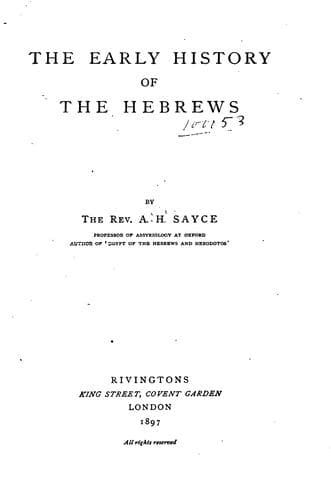
The early history of the HebrewsSayce, A. H. (Archibald Henry)
History
The early history of the Hebrews
Sayce, A. H. (Archibald Henry)
Bible. Old Testament -- Criticism, interpretation, etc.; Jews -- History -- To 953 B.C.
Samuel was clad in the linen ephod, the sacred vestment and symbol of
the priest, and ‘ministered unto Yahveh before Eli.’ One night, before
‘the lamp of God’ had gone out which burned before the ark of the
covenant,[380] ‘the word of the Lord’ came to the boy in his sleep.
Three times did it call to him, and then came the revelation of the
punishment which Yahveh was about to bring on the house of the high
priest.[381] His sons had been unfaithful to their office; not only had
they lain ‘with the women that assembled at the door of the tabernacle
of the congregation,’ they had made men abhor the offering of the Lord,
and the weak old man had restrained them not. The law had ordained that
the fat of the sacrifice belonged to Yahveh, and that before it was
burned upon the altar neither priest nor offerer could receive anything
of the victim. Unless the law was complied with, the sacrifice was
useless; Yahveh had been robbed of His portion, and no blessing could
follow upon the offering. But the sons of Eli persistently set at naught
the strict injunctions of the law. Before the fat was burned, their
servant came and struck his three-pronged fork into the flesh that had
been placed in the caldron, demanding that it should be given to him
raw. God’s priests thus mutilated the sacrifices that were made to Him,
and compelled His worshippers to defraud Him of His due. The Israelites
began to shrink from bringing their yearly offerings to Shiloh, and the
downward course of the religion of Israel was hastened by the cynical
greed of its priests.[382]
Eli had already been warned by ‘a man of God’ of the coming vengeance of
Yahveh. The prophet destined to play so important a part in the history
of Israel now appears almost for the first time upon the scene. Deborah,
indeed, had been a prophetess, and a prophet had denounced the idolatry
of his countrymen during the period of Midianitish oppression; but the
spirit of Yahveh, which, in later days, revealed itself in the form of
prophecy, had hitherto rather inspired those upon whom it had fallen to
become leaders in war and ‘judges’ of their people. Now it assumed a new
shape. Out of the misery and confusion produced by the Philistine raids
sprang the first great outburst of Hebrew prophecy. Those who still
believed Israel was the chosen people of Yahveh, and that He alone was
God over all the earth, were profoundly stirred by the triumph of the
uncircumcised. There was an outbreak of that religious enthusiasm,
degenerating at times into fanaticism, which has occurred again and
again in the East. The ‘seer’ took the place of the ‘judge.’ The waking
visions which he beheld revealed the future, and declared to him and the
people the will of Yahveh. The arms of flesh had failed; all that was
left was the ‘open vision,’ where the events of the future were pictured
beforehand, and men learned how to escape disaster.
Public-domain text, read in full here on John Shaqi.
Reviews
Reviews
No reviews yet
Be the first to share your thoughts on this work.
Elsewhere in the archive
Join the Discussion
Join the discussion
Sign in to leave a comment or review.
Sign InorCreate an account