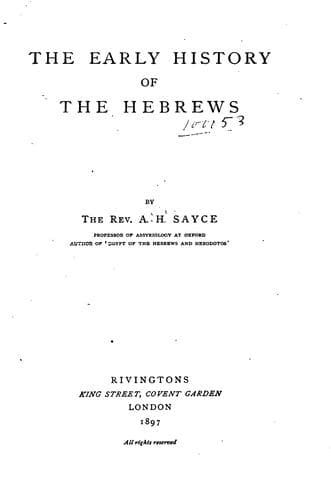
The early history of the HebrewsSayce, A. H. (Archibald Henry)
History
The early history of the Hebrews
Sayce, A. H. (Archibald Henry)
Bible. Old Testament -- Criticism, interpretation, etc.; Jews -- History -- To 953 B.C.
Around the seer there gathered bands of disciples, closely resembling
the dervishes of to-day. They, too, received a part of the prophetic
spirit, and at times, under the influence of strong emotions, passed, as
it were, out of the body into an ecstatic state. Like the modern
dervishes, however, they were completely under the control of the seer.
At a word from him their ecstasy would cease, and they would once more
become ordinary citizens of the world. But the spirit that moved in them
was easily communicated to religious or excitable natures. The
messengers sent by Saul to arrest David at Ramah were themselves
arrested by the spirit of prophecy which permeated the home of Samuel,
and when Saul himself followed in his wrath, he, too, was suddenly
overcome by the same divine influence. ‘The spirit of God was upon him
also; and he went on and prophesied, until he came to Naioth (the
convent) in Ramah. And he stripped off his clothes also, and prophesied
before Samuel in like manner, and lay down naked all that night.’
But this ecstatic excitement was not of the essence of Hebrew prophecy,
and the latter soon divested itself of it. The dervish element, indeed,
remained almost to the last; Elijah is a proof of it, and even Hosea and
Isaiah still recur at times to symbolic action. But it became
subordinate and purely symbolical, while the seer himself became a
prophet. The conception that gathered round him was no longer that of a
seer of visions, a revealer of the future, but of an interpreter of the
will of God to man. Prediction there might be in his prophecies; but it
was accidental only, and dependent on conditions which were clearly
expressed. If the people repented of their sins, God’s anger would be
turned away from them; if, on the contrary, they persisted in their evil
ways, disaster and destruction would fall upon them. The message of
Yahveh was conditional; it did not contain the revelation of an
inevitable future.
Public-domain text, read in full here on John Shaqi.
Reviews
Reviews
No reviews yet
Be the first to share your thoughts on this work.
Elsewhere in the archive
Join the Discussion
Join the discussion
Sign in to leave a comment or review.
Sign InorCreate an account