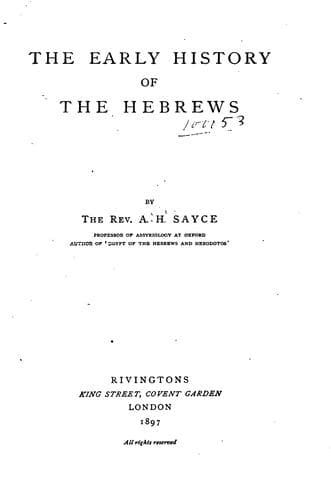
The early history of the HebrewsSayce, A. H. (Archibald Henry)
History
The early history of the Hebrews
Sayce, A. H. (Archibald Henry)
Bible. Old Testament -- Criticism, interpretation, etc.; Jews -- History -- To 953 B.C.
This, indeed, is tacitly admitted in a modern German work on Hebrew
history, which is more than once referred to in the following pages. Dr.
Kittel’s _History of the Hebrews_ is partly filled with an imposing
‘analysis’ of the documents which constitute the historical books of the
Old Testament, and we might therefore expect that the history to which
it forms an introduction would be influenced throughout by the results
of the literary disintegration. But nothing of the sort is the case. So
far as Dr. Kittel’s treatment of the history is concerned, the
‘analysis’ might never have been made; all that it does is to prove his
acquaintance with modern ‘critical’ literature. The history is judged on
its own merits without any reference to the age or character of the
‘sources’ upon which it is supposed to rest. The instinct of the
historian has been too strong for the author to resist, and the results
of the linguistic analysis have accordingly been quietly set aside.
But history also has its canons of evidence, and criticism, in the true
sense of the word, is not confined to the philologists. There is no
infallible history any more than there is infallible philology; and if
we are to understand the history of the Hebrews aright, we must deal
with it as we should with the history of any other ancient people. The
Old Testament writers were human; and in so far as they were historians,
their conceptions and manner of writing history were the same as those
of their Oriental contemporaries. They were not European historians of
the nineteenth century, and to treat them as such would be not only to
pursue a radically false method, but to falsify the history they have
recorded. No human history is, or can be, inerrant, and to claim
inerrancy for the history of Israel is to introduce into Christianity
the Hindu doctrine of the inerrancy of the Veda. For the historian, at
any rate, the questions involved in a theological treatment of the Old
Testament do not exist.
The present writer, accordingly, must be understood to speak throughout
simply as an archæologist and historian. Theologically he accepts
unreservedly whatever doctrine has been laid down by the Church as an
article of the faith. But among these doctrines he fails to find any
which forbids a free and impartial handling of Old Testament history.
Perhaps it is necessary to apologise for the multitude of unfamiliar
proper names which make the first chapter of this book somewhat
difficult reading. But they represent the archæological discoveries of
the last few years in their bearing upon the history of the Patriarchs,
and an attempt has been made to lighten the burden of remembering them
by repeating the newly-discovered facts, at all events in outline,
wherever it has been needful to allude to them. Those, however, who find
the burden too heavy and wearisome may pass on to the second chapter.
A. H. SAYCE,
23 CHEPSTOW VILLAS, W.
_September 25, 1897._
CONTENTS
Public-domain text, read in full here on John Shaqi.
Reviews
Reviews
No reviews yet
Be the first to share your thoughts on this work.
Join the Discussion
Join the discussion
Sign in to leave a comment or review.
Sign InorCreate an account