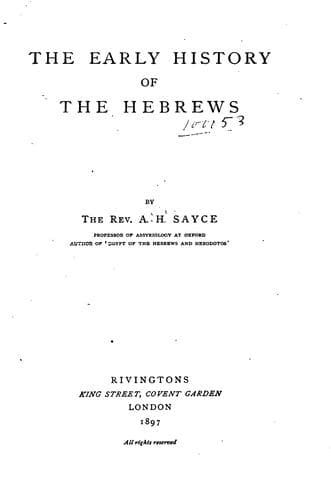
The early history of the HebrewsSayce, A. H. (Archibald Henry)
History
The early history of the Hebrews
Sayce, A. H. (Archibald Henry)
Bible. Old Testament -- Criticism, interpretation, etc.; Jews -- History -- To 953 B.C.
The actual meaning of the name is not certain, nor indeed is the
original signification of the proverb itself. Already in the time of the
Septuagint translation the meaning of the latter was doubtful, and the
Greek translators have made the divine name the subject of the verb,
reading, ‘In the mountain the Lord was seen.’ But the fact that the
Chronicler calls the temple-mount Moriah shows that such a rendering was
not accepted in Jerusalem.
It may be that the name ‘mount of the Lord’ goes back, at all events in
substance, to patriarchal times. Among the places in Southern Palestine
conquered by the Egyptian Pharaoh, Thothmes III., of the eighteenth
dynasty, and recorded on the temple walls of Karnak, is Har-el, ‘the
mountain of God.’[62] The names found in immediate connection with
Har-el indicate that its site is to be sought in the neighbourhood of
Jerusalem; and as the name of Jerusalem itself does not occur in the
Pharaoh’s list of his conquests, it is probable that we are to see in it
the future capital of Judah. As we now know from the Tel el-Amarna
tablets, Jerusalem was an important city of Canaan long before the
Mosaic age; it was, moreover, the centre of a district which had been
conquered by the Egyptians, and its ruler was a vassal of the Egyptian
monarch. It is therefore difficult to account for the omission of any
reference to it in the catalogue of the conquests of the Pharaoh except
upon the supposition that it is really mentioned among them, though
under another name.
The distance that separates Jerusalem from Beer-sheba would correspond
with the three days’ journey of Abraham to the destined place of
sacrifice. It was on the third day that Abraham lifted up his eyes ‘and
saw the place afar off.’ The main, in fact, the only, argument of any
weight that has been urged against the identification is the fact that
the place of sacrifice seems to have been a desert spot. No spectators
are mentioned as present, and close to it was a thicket in which a ram
was caught by the horns. How can such solitude, it is asked, be
reconciled with the existence of a city in the same spot? How can the
deserted high-place whereon the patriarch raised the altar of sacrifice
for his son be identical with the fortress-city of which Melchizedek was
king?
Public-domain text, read in full here on John Shaqi.
Reviews
Reviews
No reviews yet
Be the first to share your thoughts on this work.
Join the Discussion
Join the discussion
Sign in to leave a comment or review.
Sign InorCreate an account