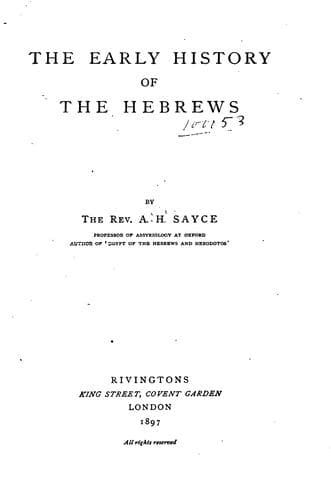
The early history of the HebrewsSayce, A. H. (Archibald Henry)
History
The early history of the Hebrews
Sayce, A. H. (Archibald Henry)
Bible. Old Testament -- Criticism, interpretation, etc.; Jews -- History -- To 953 B.C.
Footnote 37:
Nicolaus of Damascus, in Josephus _Antiq._ i. 7, 2.
Footnote 38:
See my _Patriarchal Palestine_, pp. 160, 165. The figure and name of
the god Salimmu, written in cuneiform characters, are on a gem now in
the Hermitage at St. Petersburg. The same god, under the name of
Shalman, is mentioned on a stela discovered at Sidon, and under that
of Selamanês in the inscriptions of Shêkh Barakât, north-west of
Aleppo (Clermont-Ganneau, _Études d’Archéologie orientale_ in the
_Bibliothèque de l’École des Hautes Études_, cxiii. vol. ii. pp. 36,
48; Sayce in the _Proceedings_ of the Society of Biblical Archeology,
xix. 2. p. 74).
Footnote 39:
As Professor Hommel says (_Expository Times_, Nov. 1896, p. 95), ‘The
“Mighty King” cannot possibly be the Pharaoh.’ But he seems to me to
introduce an unnecessary element of complication into the subject by
supposing that in the Tel el-Amarna letters the epithet has been
transferred to the king of the Hittites from the supreme god of
Jerusalem, to whom it properly belonged. It is true that in a letter
of the governor of Phœnicia (Winckler und Abel, No. 76, l. 66) the
title is given to the king of the Hittites, but it does not follow
that the king of Jerusalem employs it in the same way.
Footnote 40:
It should be noticed that, according to Hesykhios (_s. v._), ‘the most
high God’ of the Syrians was Ramas, that is, Ramman or Rimmon, who was
identified with the sun-god Hadad, the supreme deity of Syria. The
Babylonians called him Amurru ‘the Amorite.’
Footnote 41:
Pietschmann, _Geschichte der Phönizier_, p. 115. The suggestion was
first made by von Bunsen.
Footnote 42:
For a possible explanation of the origin of the practice, see H. N.
Moseley in the _Journal of the Anthropological Institute_, vi. 4, p.
396. Bastian gives another in his description of the practice among
the Polynesians (_Anthropologie der Naturvölker_, vi. pp. 40, 41).
Footnote 43:
A brilliant suggestion of Professor Hommel, however, may prove to be
the true explanation of the mysterious name. In the Minæan
inscriptions of Southern Arabia a long _â_ is constantly denoted in
writing by _h_; and Abraham, therefore, may be merely the Minæan mode
of writing Abram. If so, this would show that the Hebrew scribes were
once under the influence of the Minæan script, and that portions of
the Pentateuch itself may have been written in the letters of the
Minæan alphabet (Hommel, _The Ancient Hebrew Tradition_, pp. 275-277).
Dr. Neubauer has suggested to me that this also may be the explanation
of the name of Aaron (_Aharôn_), which, like Ab-raham, has no
etymology. Aaron would be the graphic form of Âron, an Arabic name
which appears as Aran in the genealogy of the Horites (Gen. xxxvi.
28).
Footnote 44:
See Berger, _L’Arabie avant Mahomet d’après les Inscriptions_ (1885),
pp. 27, 28.
Footnote 45:
Public-domain text, read in full here on John Shaqi.
Reviews
Reviews
No reviews yet
Be the first to share your thoughts on this work.
Elsewhere in the archive
Join the Discussion
Join the discussion
Sign in to leave a comment or review.
Sign InorCreate an account