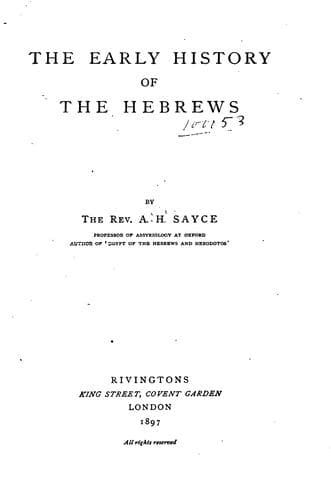
The early history of the HebrewsSayce, A. H. (Archibald Henry)
History
The early history of the Hebrews
Sayce, A. H. (Archibald Henry)
Bible. Old Testament -- Criticism, interpretation, etc.; Jews -- History -- To 953 B.C.
D. H. Müller, _Epigraphische Denkmäler aus Arabien_ (1889), p. 13.
Footnote 46:
Thus we have _anuki_ ‘I,’ Heb. _anochi_; _badiu_ ‘in his hand,’ Heb.
_b’yado_; _akharunu_ ‘after him,’ Heb. _akharono_; _rusu_ ‘head,’ Heb.
_rosh_; _kilubi_ ‘cage,’ Heb. _chelûb_; _har_ ‘mountain,’ Heb. _har_.
See my _Patriarchal Palestine_, p. 247.
Footnote 47:
On the question of the site of Mizpah of Gilead, see G. A. Smith, _The
Historical Geography of the Holy Land_, pp. 586, 587.
Footnote 48:
_Ausgrabungen in Sendschirli_ in _Mittheilungen aus den orientalischen
Sammlungen_, xi. (1893).
Footnote 49:
_Records of the Past_, new ser., v. pp. vi, vii.
Footnote 50:
Dussaud (_Revue Archéologique_, iii. xxx. p. 346) states that
according to the Ansarîyeh of the Gulf of Antioch the ‘Yudi’ or
Hebrews formerly occupied their country, and constructed the ancient
monuments found in it, one of which is called after the name of
Solomon. For Neubauer’s suggestion that the Dinhabah of Gen. xxxvi. 32
is identical in name with the Dunip or Tunip of Northern Syria, see
further on.
Hoffmann (_Zeitschrift für Assyriologie_, xi. p. 210) maintains that
the origin of the Aramaic dialects is to be sought in a Bedâwin
language allied to that of the Arabs and Sabæans, which underwent
intermixture with Canaanitish (or Phœnician) through the settlement of
its speakers in a Canaanitish country.
Footnote 51:
In Assyrian letters of the Second Empire mention is made of the
Nabathean Â-kamaru, the son of Amme’te’, and the Arabian Ami-li’ti,
the son of Ameri or Omar (Harper, _Assyrian and Babylonian Letters_,
iii. p. 262; iv. p. 437).
Footnote 52:
It is stated in Deut. xxiii. 4 that Balaam was hired from ‘Pethor of
Aram Naharaim,’ not only by the Moabites, but by the Ammonites as well
(though it is true that in the Hebrew text the word _sâkar_, ‘hired,’
is in the singular). It may be noted that the mother of Rehoboam,
whose name is compounded with that of Am or Ammi (compare Rehab-iah, 1
Chron. xxiii. 17), was an Ammonitess (1 Kings xiv. 21). For a full
discussion of the name of ’Ammi or ’Ammu, and the historical
conclusions which may be deduced from it, see Hommel, _The Ancient
Hebrew Tradition_, pp. 89 _sqq._
Footnote 53:
Public-domain text, read in full here on John Shaqi.
Reviews
Reviews
No reviews yet
Be the first to share your thoughts on this work.
Elsewhere in the archive
Join the Discussion
Join the discussion
Sign in to leave a comment or review.
Sign InorCreate an account