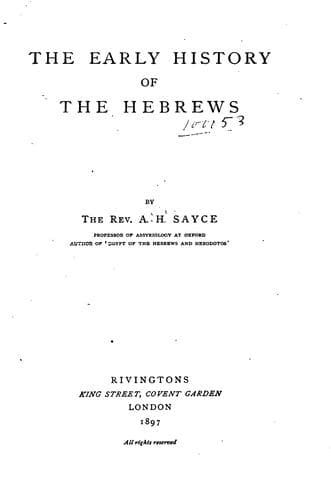
The early history of the HebrewsSayce, A. H. (Archibald Henry)
History
The early history of the Hebrews
Sayce, A. H. (Archibald Henry)
Bible. Old Testament -- Criticism, interpretation, etc.; Jews -- History -- To 953 B.C.
Cf. Gen. xlix. 14, 15. The Hebrew word rendered ‘two burdens’ by the
Authorised Version in v. 14 should be translated ‘sheepfolds,’ as it
is in Judg. v. 16.
Footnote 90:
Thus the ancient Abshek, the Abokkis of classical geography, has
become Abu Simbel, or ‘father of an ear of corn’; and Silsila is said
to have derived its name from a ‘chain’ or _silsila_ stretched across
the Nile from the rocks on either bank, though it really has its
origin in the classical Silsilis, the Coptic Joljel or ‘barrier.’
Footnote 91:
In the list of Thothmes III. the name of Nekeb of Galilee (Josh. xix.
33) is followed by that of Ashushkhen, which may be compared with
Issachar, since the interchange of final _n_ and _r_ is not uncommon.
But the substitution of _kh_ for _k_ (_ch_) is difficult to account
for.
Footnote 92:
Shmâna is the thirty-fifth name in the Palestine list of Thothmes, and
follows the name of Chinnereth (Josh. xix. 35; comp. also Shmânau, No.
18. See Tomkins in _Records of the Past_, new series, v. pp. 44, 46).
One of the Tel el-Amarna tablets (W. and A. ii., No. 39) mentions ‘the
Yaudu’ in the neighbourhood of Tunip, now Tennib, north-west of
Aleppo. The name of the Jews is written in the same way in the
cuneiform texts, though the Yaudu of the Tel el-Amarna tablets are
probably to be identified with the land of Ya’di, which the
inscriptions of Sinjerli place in Northern Syria. But it is noticeable
that the Tel el-Amarna correspondence makes Kinza a district near
Kadesh on the Orontes, close to the Lake of Homs, and Kinza is letter
for letter the Biblical Kenaz. The Kenizzites, it will be remembered,
formed an integral part of the later tribe of Judah.
Footnote 93:
Hommel, _Aufsätze und Abhandlungen sur Kunde der Sprachen, Literaturen
und der Geschichte des vorderen Orients_ (1890), p. 31.
Footnote 94:
The Rev. H. G. Tomkins (_Quarterly Statement_ of the Palestine
Exploration Fund, April 1885) first pointed out the true signification
of the name of Beth-lehem, Lakhmu was one of the primeval gods of
Chaldæan religion.
Footnote 95:
The village of Rachel, which was probably where the stone stood, is
referred to in 1 Sam. xxx. 29.
Footnote 96:
_E.g._ _Yeôr_, ‘river,’ Egyptian _aur_; _akhu_, ‘herbage on the river
bank’ (Gen. xli. 2), Egyptian _akhu_; _rebid_, ‘collar,’ Egyptian
_repit_. See Ebers, _Aegypten und die Bücher Mose’s_, pp. 337-339.
Footnote 97:
See my _Egypt of the Hebrews and Herodotos_, pp. 25 _sq._
Footnote 98:
See Tomkins, _Life and Times of Joseph_, p. 184.
Footnote 99:
Asenath is probably Nes-Nit, ‘Attached to Neith,’ as Subanda is
Nes-Bandid, ‘Attached to Bandid.’
Footnote 100:
Mattan-Baal. The corresponding Hebrew name is Mattaniah.
Footnote 101:
Public-domain text, read in full here on John Shaqi.
Reviews
Reviews
No reviews yet
Be the first to share your thoughts on this work.
Elsewhere in the archive
Join the Discussion
Join the discussion
Sign in to leave a comment or review.
Sign InorCreate an account