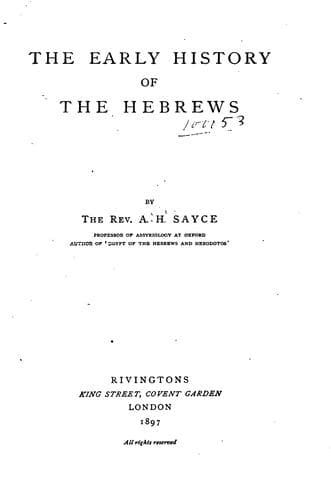
The early history of the HebrewsSayce, A. H. (Archibald Henry)
History
The early history of the Hebrews
Sayce, A. H. (Archibald Henry)
Bible. Old Testament -- Criticism, interpretation, etc.; Jews -- History -- To 953 B.C.
Jacob-el is written Ya’akub-ilu; Joseph-el, Yasupu-ilu and Yasup-il,
which is found in a list of slaves of the same early age (Bu. 91-5-9,
324). In the same list mention is made of land belonging to Adunum,
the Heb. _adon_, and to Nakha-ya, which is a parallel formation to the
Heb. Noah. In a tablet dated in the reign of Zabium, the founder of
the dynasty to which Khammu-rabi or Amraphel belonged, we find the
name of Ya-kh-ku-ub-il, _i.e._ Ya’qub-il (Bu. 91-5-9, 387).
Footnote 80:
Iqib-ilu and Asupi-ilu.
Footnote 81:
See _Records of the Past_, new ser., v. pp. 48, 51.
Footnote 82:
One of the scarabs of Ya’qob-el is in the Egyptian Museum of
University College, London. _El_ is written _h(a)l_.
Footnote 83:
On the summit of the hill above Beitîn, the ancient Beth-On or
Beth-el, the strata of limestone rock take the form of vast steps
rising one above the other.
Footnote 84:
Cf. the article of Mr. Pinches on ‘Gifts to a Babylonian Bit-ili’ in
the _Babylonian and Oriental Record_, ii. 6.
Footnote 85:
See, for example, Peiser, _Texte juristischen und geschäftlichen
Inhalts_ (_Keilinschriftliche Bibliothek_, iv.), p. 49, No. iii.,
where Ubarum hires himself out to Ana-Samas-litsi for a month, for
half a shekel of silver.
Footnote 86:
_Records of the Past_, new ser., v. p. 169.
Footnote 87:
Deut. xxxii. 15. See also Deut. xxxiii. 5, 26; Isa. xliv. 2.
Footnote 88:
According to immemorial tradition, the site of the field is marked by
Jacob’s Well (S. John iv. 6). Dr. Masterman in the _Quarterly
Statement_ of the Palestine Exploration Fund, April 1897, gives for
the first time a satisfactory explanation why this deep well, which is
often dry in summer, should have been sunk in the neighbourhood of a
number of springs:—‘The springs have probably always belonged to the
townsfolk (since they became settled); and, in the case of any
wandering tribes with considerable flocks among them, it is
exceedingly probable that the more settled inhabitants would first
resent and then resist the new-comers marching twice daily into their
midst to water their flocks at their springs, Probably any experienced
nomad with such flocks, accustomed to such a country as this, would
know pretty surely where he might, from the conformation of the hills,
expect to find water. If, then, a quarrel arose, what more probable
than that he should seek to make himself independent of these
disagreeable neighbours. Further, if we can accept the tradition, we
have, in the story of Jacob, two special facts connected with this:
firstly, he bought a piece of ground on which he could make a well for
himself; and then we gather from Genesis xxxiv. that his family made
themselves sufficiently obnoxious to the Shechemites to make it very
necessary for Jacob to be independent of their permission to use their
springs.’
Footnote 89:
Public-domain text, read in full here on John Shaqi.
Reviews
Reviews
No reviews yet
Be the first to share your thoughts on this work.
Elsewhere in the archive
Join the Discussion
Join the discussion
Sign in to leave a comment or review.
Sign InorCreate an account