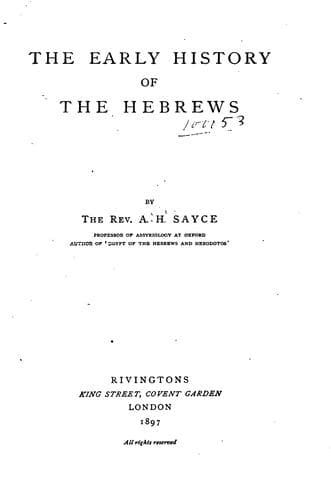
The early history of the HebrewsSayce, A. H. (Archibald Henry)
History
The early history of the Hebrews
Sayce, A. H. (Archibald Henry)
Bible. Old Testament -- Criticism, interpretation, etc.; Jews -- History -- To 953 B.C.
Thus in the Tel el-Amarna tablets, Rib-Hadad, the governor of
Phœnicia, asks the Pharaoh to send corn to Gebal, as the crops there
had failed (Winckler and Abel, No. 48, ll. 8-19), and Meneptah sent
corn to the Hittites when they suffered from a famine (Brugsch, _Egypt
under the Pharaohs_, Eng. tr., 2nd edit., ii. p. 119).
Footnote 118:
According to Abulfarag (_Chron._ p. 14), Joseph became Vizier in the
seventeenth year of the reign of Apopi. Maspero (_Struggle of the
Nations_, pp. 59, 107) makes Apopi Ra-aa-kenen the third of the name.
Footnote 119:
See Maspero’s translation in _Records of the Past_, new ser., ii. pp.
37 _sq._
Footnote 120:
E. Naville, _Goshen and the Shrine of Saft el-Hennah_, Fourth Memoir
of the Egypt Exploration Fund (1887), pp. 14 _sq._
Footnote 121:
See Naville, _Goshen_, p. 26.
Footnote 122:
_Bibl. Hist._, i. 91.
Footnote 123:
N. H. xix. 5.
Footnote 124:
Abel-Mizraim may be the Abel that is mentioned in connection with the
‘gardens,’ the ‘tilth,’ and the ‘spring’ of Carmel of Judah in the
list of places in Canaan conquered by Thothmes III. (No. 92). Another
Abel is mentioned two names earlier (No. 90).
Footnote 125:
See Virey’s translation in _Records of the Past_, new ser., iii. p.
34.
CHAPTER II
THE COMPOSITION OF THE PENTATEUCH
The Literary Analysis and its Conclusions—Based on a Theory and an
Assumption—Weakness of the Philological Evidence—Disregard of the
Scientific Method of Comparison—Imperfection of our Knowledge of
Hebrew—Archæology unfavourable to the Higher Criticism—Analysis of
Historical Sources—Tel el-Amarna Tablets—Antiquity of Writing in the
East—The Mosaic Age highly Literary—Scribes mentioned in the Song of
Deborah—The Story of the Deluge brought from Babylonia to Canaan
before the time of Moses—The Narratives of the Pentateuch confirmed
by Archæology—Compiled from early Written Documents—Revised and
re-edited from time to time—Three Strata of Legislation—Accuracy in
the Text—Tendencies—Chronology.
The book of Genesis ends with the death of Joseph. When the five books
of the Pentateuch were divided from one another we do not know. The
division is older than the Septuagint translation, older too than the
time when the Law of Moses was accepted by the Samaritans as divinely
authoritative. As far back as we can trace the external history of the
Pentateuch, it has consisted of five books divided from one another as
they still are in our present Bibles.
Public-domain text, read in full here on John Shaqi.
Reviews
Reviews
No reviews yet
Be the first to share your thoughts on this work.
Elsewhere in the archive
Join the Discussion
Join the discussion
Sign in to leave a comment or review.
Sign InorCreate an account