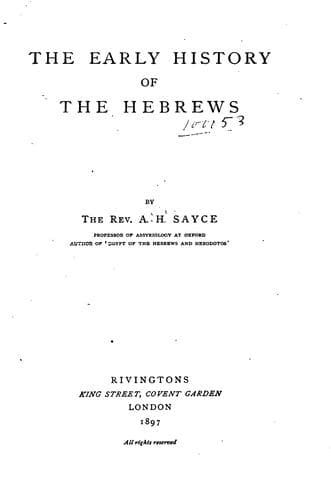
The early history of the HebrewsSayce, A. H. (Archibald Henry)
History
The early history of the Hebrews
Sayce, A. H. (Archibald Henry)
Bible. Old Testament -- Criticism, interpretation, etc.; Jews -- History -- To 953 B.C.
There is yet another reason why the new theory of the origin of the
Mosaic Law stands self-condemned. It deals with the writers and readers
of the ancient East as if they were modern German professors and their
literary audience. The author of the Priestly Code is supposed to go to
work with scissors and paste, and with a particular object in view, like
a rather wooden and unimaginative compiler of to-day. And so closely did
the minds and methods of the authors of the Hexateuch resemble those of
their modern European critics, that in spite of their efforts to conceal
the piecemeal nature of their work, as well as of the fact that it
actually deceived their countrymen to whom it was addressed, to the
European scholar of to-day it all lies open and revealed. When, however,
we turn to other products of Oriental thought, whether ancient or
modern, we do not find that this is the way in which the authors of them
have written history, or what purports to be history, neither do we find
their readers to be at all like those for whom the Hexateuch is supposed
to have been compiled. The point of view of an Oriental is still
essentially different from that of a European, at all events so far as
history and literature are concerned; and the attempt to transform the
ancient Israelitish historians into somewhat inferior German compilers
proves only a strange want of familiarity with Eastern modes of thought.
But it is not only science, it is common sense as well, which is
violated by the endeavour to foist philological speculations into the
treatment of historical questions. Hebrew is a dead language; it is
moreover a language which is but imperfectly known. Our knowledge of it
is derived entirely from that fragment of its literature which is
preserved in the Old Testament, and the errors of copyists and the
corruptions of the text make a good deal even of this obscure and
doubtful. There are numerous words, the traditional rendering of which
is questionable; there are numerous others in the case of which it is
certainly wrong; and there is passage after passage in which the
translations of scholars vary from one another, sometimes even to
contradiction. Of both grammar and lexicon it may be said that we see
them through a glass darkly. Not unfrequently the reading of the
Septuagint—the earliest manuscript of which is six hundred years older
than the earliest manuscript of the Hebrew text—differs entirely from
the reading of the Hebrew; and there is a marked tendency among the
Hexateuchal analysts to prefer it, though the recently-discovered Hebrew
text of the book of Ecclesiasticus seems to show that the preference is
not altogether justified.
Public-domain text, read in full here on John Shaqi.
Reviews
Reviews
No reviews yet
Be the first to share your thoughts on this work.
Elsewhere in the archive
Join the Discussion
Join the discussion
Sign in to leave a comment or review.
Sign InorCreate an account