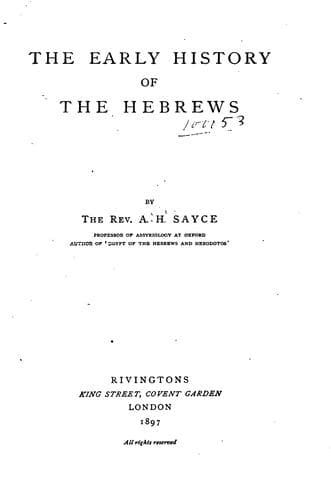
The early history of the HebrewsSayce, A. H. (Archibald Henry)
History
The early history of the Hebrews
Sayce, A. H. (Archibald Henry)
Bible. Old Testament -- Criticism, interpretation, etc.; Jews -- History -- To 953 B.C.
When, however, we come to examine the philological evidence upon which
we are asked to accept this new reading of ancient Hebrew history, we
find that it is wofully defective. We are asked to believe that a
European scholar of the nineteenth century can analyse with mathematical
precision a work composed centuries ago in the East for Eastern readers
in a language that is long since dead, can dissolve it verse by verse,
and even word by word, into its several elements, and fix the
approximate date and relation of each. The accomplishment of such a feat
is an impossibility, and to attempt it is to sin as much against common
sense as against the laws of science. Science teaches us that we can
attain to truth only by the help of comparison; we can know things
scientifically only in so far as they can be compared and measured one
with another. Where there is no comparison there can be no scientific
result. Even the logicians of the Middle Ages taught that no conclusion
can be drawn from what they termed a single instance. It is just this,
however, that the Hexateuchal critics have essayed to do. The Pentateuch
and its history have been compared with nothing except themselves, and
the results have been derived not from the method of comparison, but
from the so-called ‘tact’ and arbitrary judgment of the individual
scholar. Certain postulates have been assumed, the consequences of which
have been gradually evolved, one after another, while the coherence and
credibility of the general hypothesis has been supported by the
invention of further subordinate hypotheses as the need for them arose.
The ‘critical’ theory of the origin and character of the Hexateuch
closely resembles the Ptolemaic theory of the universe; like the latter,
it is highly complicated and elaborate, coherent in itself, and perfect
on paper, but unfortunately baseless in reality.
Its very complication condemns it. It is too ingenious to be true. Had
the Hexateuch been pieced together as we are told it was, it would have
required a special revelation to discover the fact. We may lay it down
as a general rule in science that the more simple a theory is, the more
likely it is to be correct. It is the complicated theories, which demand
all kinds of subsidiary qualifications and assistant hypotheses, that
are put aside by the progress of science. The wit of man may be great,
but it needs a mass of material before even a simple theory can be
established with any pretence to scientific value.
Public-domain text, read in full here on John Shaqi.
Reviews
Reviews
No reviews yet
Be the first to share your thoughts on this work.
Elsewhere in the archive
Join the Discussion
Join the discussion
Sign in to leave a comment or review.
Sign InorCreate an account