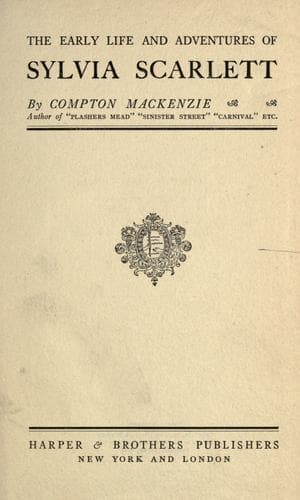
The Early Life and Adventures of Sylvia ScarlettMacKenzie, Compton
General
The Early Life and Adventures of Sylvia Scarlett
MacKenzie, Compton
Fiction
The breakfast-room was placed below the level of the street. Here, in an
atmosphere of cat-haunted upholstery and broken springs, of overcooked
vegetables and dingy fires, yet withal of a kind of frowsy comfort,
Sylvia sometimes met the other lodgers. One of them was Baron von
Statten, a queer German, whom Sylvia could not make out at all, for he
spoke English as if he had been taught by a maid-of-all-work with a bad
cold, powdered his pink face, and wore three rings, yet was so poor that
sometimes he stayed in bed for a week at a stretch, pending negotiations
with his laundress. The last piece of information Sylvia obtained from
Clara, the servant, who professed a great contempt for the baron. Mrs.
Meares, on the other hand, derived much pride from his position in her
house, which she pointed out was really that of an honored guest, since
he owed now nearly seven weeks' rent; she never failed to refer to him
by his title with warm affection. Another lodger was a Welsh pianist
called Morgan, who played the piano all day long and billiards for as
much of the night as he could. He was a bad-tempered young man with long
black hair and a great antipathy to the baron, whom he was always trying
to insult; indeed, once at breakfast he actually poured a cup of coffee
over him.
"Mr. Morgan!" Mrs. Meares had cried. "No Irishman would have done that."
"No Irishman would ever do anything," the pianist snapped, "if he could
get somebody else to do it for him."
Sylvia welcomed the assault, because the scalding coffee drove the baron
to unbutton his waistcoat in a frenzy of discomfort and thereby
confirmed Clara's legend about the scarcity of his linen.
The third lodger was Mr. James Monkley, about whom Sylvia was undecided;
sometimes she liked him very much, at other times she disliked him
equally. He had curly red hair, finely cut red lips, a clear complexion,
and an authoritative, determined manner, but his eyes, instead of being
the pleasant blue they ought to have been in such a face, were of a
shade of muddy green and never changed their expression. Sylvia once
mentioned about Mr. Monkley's eyes to Clara, who said they were like a
fish.
"But Monkley's not like a fish," Sylvia argued.
"I don't know what he's like, I'm sure," said Clara. "All I know is he
gives any one the creeps something shocking whenever he stares, which
he's forever doing. Well, fine feathers don't make a summer and he looks
best who looks last, as they say."
One reason for disliking Mr. Monkley was his intimacy with her father.
Sylvia would not have objected to this if it had not meant long
confabulations during which she was banished from the room and, what was
worse, thrown into the society of Mrs. Meares, who always seemed to
catch her when she was trying to make her way down-stairs to Clara.
Public-domain text, read in full here on John Shaqi.
Reviews
Reviews
No reviews yet
Be the first to share your thoughts on this work.
Join the Discussion
Join the discussion
Sign in to leave a comment or review.
Sign InorCreate an account