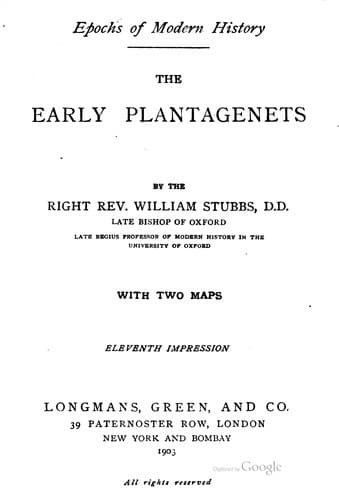
Great Britain -- History -- Plantagenets, 1154-1399; Plantagenet, House of
The quarrel with his wife and the mistrust of his children threw the
king under very evil influences, although as a king he tried hard to do
his duty; and they sowed the seed of later difficulties which at last
overwhelmed him. The internal history of these years is occupied with
the judicial and financial doings which have been sketched in the early
pages of this chapter; outside there was peace, except in Poictou,
where Richard was learning the art of war, winning his first laurels
and making his worst and most obstinate enemies.
[Sidenote:
Accession of
Phillip II.,
1179.
]
In 1180 the long strife and jealousy between Henry II., and Lewis
VII., came to an end. The weak and unprincipled King of France, after
resigning his crown to his son Philip, a boy of sixteen, retired into
a convent and died. Philip inherited all his hatred of Henry, although
he was better able to appreciate his wisdom, and showed in his early
years a desire to have him as a political adviser and instructor. He
inherited, too, all his father’s falseness, craft, and dishonesty,
but not his morbid conscience nor his irresoluteness. Without being
so great a coward as his father, Philip was yet a long way from
being a brave man, and loses much by his juxtaposition with Richard
and even with John in that respect. But he was very unscrupulous,
very pertinacious, and in result very successful, outliving all his
rivals, and leaving his kingdom immensely stronger than it was when
he succeeded to it. In the domestic quarrels of his early years, with
his stepmother and the counts of Champagne, he availed himself of the
advice of Henry, which was given honestly and effectually; but, after
Henry’s quarrels with his sons began again, Philip saw his way clearly
enough to the humiliation of the rival house; and he took too sure and
too fatal advantage of his opportunity.
There is no need to dwell on the events of 1181 and 1182; the chief
mark of the former year is that assize of arms which has been already
mentioned. In 1182 the king was a good deal in Poictou. England
was governed now, and chiefly for the rest of the reign, by Ranulf
Glanvill, the chief justiciar, who in 1180 or 1179 had succeeded
to Richard de Lucy. The country was quiet; so quiet, that when the
troubles began on the Continent not a hand or foot in England stirred
against the king. English history during these and the following years
is a simple record of steady growth; all interest, personal and
political, centres in the king.
[Sidenote:
Second
revolt of the
young king.
]
[Sidenote:
His death,
1183.
]
Public-domain text, read in full here on John Shaqi.
Reviews
Reviews
No reviews yet
Be the first to share your thoughts on this work.
Elsewhere in the archive
Join the Discussion
Join the discussion
Sign in to leave a comment or review.
Sign InorCreate an account