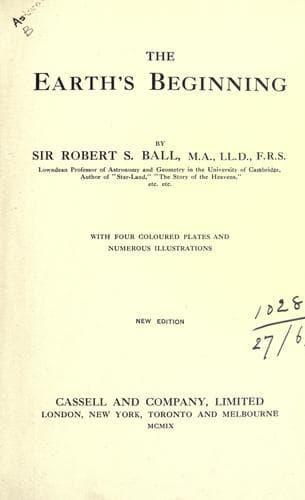
The Earth's BeginningBall, Robert S. (Robert Stawell)
Science
The Earth's Beginning
Ball, Robert S. (Robert Stawell)
Krakatoa (Indonesia); Nebular hypothesis
Such has been the Earth’s Beginning so far as modern science can make it
clear to us. We have at least indicated the course which events must
have taken according to the laws of nature as we understand them. Many
of the details of the great evolution are no doubt unknown at present,
and perhaps must ever remain so. That the events which we have
endeavoured to describe do substantially represent the actual evolution
of our system is the famous Nebular Theory.
------------------------------------------------------------------------
CHAPTER IX.
EARTHQUAKES AND VOLCANOES.
Interior of the Earth—Illustration from Norway—Solids and
Liquids—Rigidity of the Interior of the Earth—Earthquakes,
how caused—Their Testimony as to the Rigidity of the
Earth—Delicate Instrument for Measuring Earthquake Tremors—The
Seismometer—Professor Milne’s Work in the Isle of Wight—Different
Earthquake Groups—Precursors and Echoes—Vibrations transmitted
through the Earth’s Centre—Earthquakes in England—Other Evidence of
the Earth’s Rigidity—Krakatoa, August 27th, 1883—The Sounds from
Krakatoa—The Diverging Waves—The Krakatoa Dust—The Hurricane
Overhead—Strange Signs in the Heavens—The Blood-red Skies.
IN this chapter we shall learn what we can as to the physical condition
of the interior of our earth so far as it may be reasonably inferred
from the facts of observation. We have already explained in the last
chapter that a very high temperature must be found at the depth of even
a small fraction of the earth’s radius, and we have pointed out that the
excessively high pressure characteristic of the earth’s interior must be
borne in mind in any consideration as to the condition of the matter
there found.
Let us take, for instance, that primary question in terrestrial physics,
as to whether the interior of the earth is liquid or solid. If we were
to judge merely from the temperatures reasonably believed to exist at a
depth of some twenty miles, and if we might overlook the question of
pressure, we should certainly say that the earth’s interior must be in a
fluid state. It seems at least certain that the temperatures to be found
at depths of two score miles, and still more at greater depths, must be
so high that the most refractory solids, whether metals or minerals,
would at once yield if we could subject them to such temperatures in our
laboratories. At such temperatures every metal would become fluid, even
if it were not transformed into a cloud of vapour. But none of our
laboratory experiments can tell us whether, under the pressure of
thousands of tons on the square inch, the application of any heat
whatever would be adequate to transform solids into liquids. It may
indeed be reasonably doubted whether the terms solids and liquids are
applicable, in the sense in which we understand them, to the materials
forming the interior of the earth.
Public-domain text, read in full here on John Shaqi.
Reviews
Reviews
No reviews yet
Be the first to share your thoughts on this work.
Elsewhere in the archive
Join the Discussion
Join the discussion
Sign in to leave a comment or review.
Sign InorCreate an account