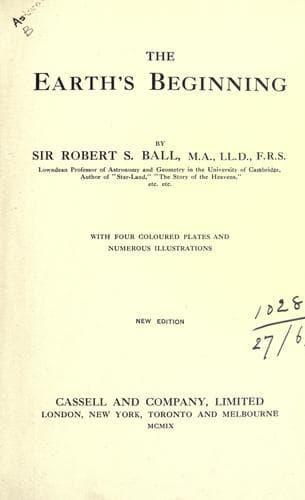
The Earth's BeginningBall, Robert S. (Robert Stawell)
Science
The Earth's Beginning
Ball, Robert S. (Robert Stawell)
Krakatoa (Indonesia); Nebular hypothesis
It was my good fortune some years ago to enjoy a most interesting trip
to Norway, in company with a distinguished geologist. Under his guidance
I there saw evidence which demonstrates conclusively that, when
subjected to great pressure, solids, as we should call them, behave in a
manner which, if not that of actual liquids, resembles at all events in
some of its characteristics the behaviour of liquids. These rocks in
some places are conglomerates, of which the leading constituents are
water-worn pebbles of granite. These pebbles are of various sizes, from
marbles to paving-stones. In some parts of the country these granite
pebbles remain in the form which they acquired on the beach on which
they were rolled by the primæval ocean; in other parts of the same
interesting region the form of the pebbles has been greatly changed from
what it was originally. For in the course of geological periods, and
after the pebbles had become consolidated into the conglomerate, the
rock so formed had been in some cases submitted to enormous pressure.
This may have been lateral pressure, such as is found to have occurred
in many other places, where it has produced the well-known geological
phenomenon of strata crumpled into folds. In the present case, however,
it seemed more probable that it was the actual weight of the
superincumbent rocks, which once lay over these beds of conglomerate,
which produced the surprising transformation. It seems to be not at all
improbable that at one time these beds of conglomerate must have been
covered with strata of which the thickness is so great that it may
actually be estimated by miles. There has, however, been immense
denudation of the superficial rocks in this part, at all events, of
Norway, so that in the course of ages these strata, overlying the
conglomerate for ages, have been so far worn away, and indeed removed,
by the action of ice and the action of water that the conglomerate is
now exposed to view. It offers for our examination striking indications
of the enormous pressure to which it was subjected during the
incalculable ages of geological time.
Public-domain text, read in full here on John Shaqi.
Reviews
Reviews
No reviews yet
Be the first to share your thoughts on this work.
Elsewhere in the archive
Join the Discussion
Join the discussion
Sign in to leave a comment or review.
Sign InorCreate an account