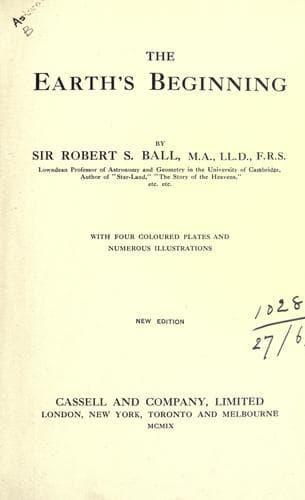
The Earth's BeginningBall, Robert S. (Robert Stawell)
Science
The Earth's Beginning
Ball, Robert S. (Robert Stawell)
Krakatoa (Indonesia); Nebular hypothesis
After a little time we learned what had actually happened. The dust
manufactured by the supreme convulsion was whirled round the earth in
the mighty atmospheric current into which the volcano discharged it. As
the dust-cloud was swept along by this incomparable hurricane, it showed
its presence in the most glorious manner by decking the sun and the moon
in hues of unaccustomed splendour and beauty. The blue colour in the sky
under ordinary circumstances is due to particles in the air, and when
the ordinary motes of the sunbeam were reinforced by the introduction of
the myriads of motes produced by Krakatoa, even the sun itself sometimes
showed a blue tint. Thus the progress of the great dust-cloud was traced
out by the extraordinary sky effects it produced, and from the progress
of the dust-cloud we inferred the movements of the invisible air current
which carried it along. Nor need it be thought that the quantity of
material projected from Krakatoa should have been inadequate to produce
effects of this worldwide description. Imagine that the material which
was blown to the winds of heaven by the supreme convulsion of Krakatoa
could be all recovered and swept into one vast heap. Imagine that the
heap were to have its bulk measured by a vessel consisting of a cube one
mile long, one mile broad, and one mile deep; it has been estimated that
even this prodigious vessel would have to be filled to the brim at least
ten times before all the products of Krakatoa had been measured.
It was in the late autumn of 1883 that the marvellous series of
celestial phenomena connected with the great eruption began to be
displayed in Great Britain. Then it was that the glory of the ordinary
sunsets was enhanced by a splendour which has dwelt in the memory of all
those who were permitted to see them. The frontispiece of this volume
contains a view of the sunset as seen at Chelsea at 4.40 p.m. on
November 26th, 1883. The picture was painted from nature by Mr. W.
Ascroft, and is given in the great work on Krakatoa which was published
by the Royal Society. There is not the least doubt that it was the dust
from Krakatoa which produced the beauty of those sunsets, and so long as
that dust remained suspended in our atmosphere, so long were strange
signs to be witnessed in the heavenly bodies. But the dust which had
been borne with unparalleled violence from the interior of the volcano,
the dust which had been shot aloft by the vehemence of the eruption to
an altitude of twenty miles, the dust which had thus been whirled round
and round our earth for perhaps a dozen times or more in this air
current, which carried it round in less than a fortnight, was endowed
with no power to resist for ever the law of gravitation which bids it
fall to the earth. It therefore gradually sank downwards. Owing,
however, to the great height to which it had been driven, owing to the
impetuous nature of the current by which it was hurried along, and owing
Public-domain text, read in full here on John Shaqi.
Reviews
Reviews
No reviews yet
Be the first to share your thoughts on this work.
Elsewhere in the archive
Join the Discussion
Join the discussion
Sign in to leave a comment or review.
Sign InorCreate an account