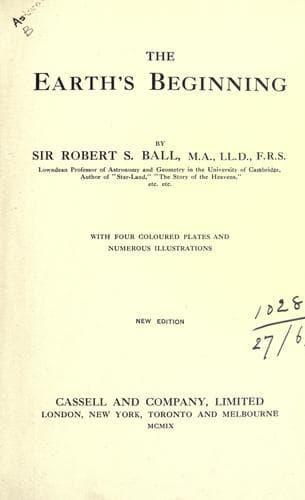
The Earth's BeginningBall, Robert S. (Robert Stawell)
Science
The Earth's Beginning
Ball, Robert S. (Robert Stawell)
Krakatoa (Indonesia); Nebular hypothesis
are performed precisely as if all bodies of the universe foreign to the
solar system were non-existent. This consideration shows that in the
problem we are now to consider, we are introducing no unreasonable
element when we premise that the system whose movements we are to
investigate is to be regarded as free from appreciable disturbance by
any foreign influence.
To follow the fortunes of a system of bodies, large or small, starting
under any arbitrary conditions at the commencement, and then abandoned
to their mutual attractions, is a problem for the mathematician. It
certainly presents to him questions of very great difficulty, and many
of these he has to confess are insoluble; there are, however, certain
important laws which must be obeyed in all the vicissitudes of the
motion. There are certain theorems known to the mathematician which
apply to such a system, and it is these theorems which afford us most
interesting and instructive information. I am well aware that the
subject upon which I am about to enter is not a very easy one, but its
importance is such that I must make the effort to explain it.
Let me commence by describing what is meant when we speak of the energy
of a system. Take, first, the case of merely two bodies, and let us
suppose that they were initially at rest. The energy of a system of this
very simple type is represented by the quantity of work which could be
done by allowing these two bodies to come together. If, instead of being
in the beginning simply at rest, the bodies had each been in motion, the
energy of the system would be correspondingly greater. The energy of a
moving body, or its capacity of doing work in virtue of its movement, is
proportional jointly to its mass and to the square of its velocity. The
energy of the two moving bodies will therefore be represented by three
parts; first, there will be that due to their distance apart; secondly,
there will be that due to the velocity of one of them; and, thirdly,
there is that due to the velocity of the other. In the case of a number
of bodies, the energy will consist in the first place of a part which is
due to the separation of the bodies, and measured by the quantity of
work that would be produced if, in obedience to their mutual attraction,
all the bodies were allowed to come together into one mass. In the
second place, the bodies are to be supposed to have been originally
started with certain velocities, and the energy of each of the bodies,
in virtue of its motion, is to be measured by the product of one-half
its mass into the square of its velocity. The total energy of the system
consists, therefore, of the sum of the parts due to the velocities of
the bodies, and that which is due to their mutual separation.
Public-domain text, read in full here on John Shaqi.
Reviews
Reviews
No reviews yet
Be the first to share your thoughts on this work.
Elsewhere in the archive
Join the Discussion
Join the discussion
Sign in to leave a comment or review.
Sign InorCreate an account