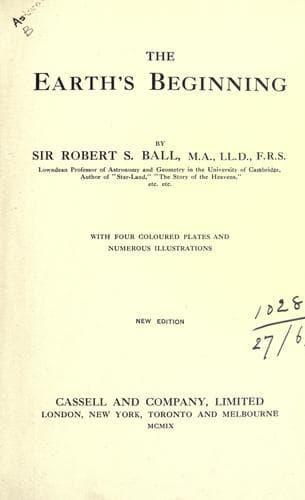
The Earth's BeginningBall, Robert S. (Robert Stawell)
Science
The Earth's Beginning
Ball, Robert S. (Robert Stawell)
Krakatoa (Indonesia); Nebular hypothesis
If the bodies could really be perfectly rigid, unyielding masses, so
that they have no movements analogous to tides, and if their movements
be such that collisions will not take place among them, then the laws of
mechanics tell us that the quantity of energy in that system will remain
for ever unaltered. The velocities of the particles may vary, and the
mutual distances of the particles may vary, but those variations will be
always conducted, subject to the fundamental condition that if we
multiply the square of the velocity of each body by one-half its mass,
and add all those quantities together, and if we increase the sum thus
obtained by the quantity of energy equivalent to the separation of the
particles, the total amount thus obtained is constant. This is the
fundamental law of mechanics known as the conservation of energy.
For such material systems as the universe presents to us, the
conservation of energy, in the sense in which I have here expressed it,
will not be maintained; for the necessary conditions cannot be
fulfilled. Let us suppose that the incessant movements of the bodies in
the system, rushing about under the influence of their mutual
attractions, has at last been productive of a collision between two of
the bodies. We have already explained in Chapter VI. how in the
collision of two masses the energy which they possess in virtue of their
movements may be to a large extent transformed into heat; there is
consequently an immediate increase in the temperature of the bodies
concerned, and then follows the operation of that fundamental law of
heat, by which the excess of heat so arising will be radiated away. Some
of it will, no doubt, be intercepted by falling on other bodies in the
system, and the amount that might be thus possibly retained would, of
course, not be lost to the system. The bodies of the solar system at
least are so widely scattered, that the greater part of the heat would
certainly escape into space, and the corresponding quantity of energy
would be totally lost to the system. We may generally assume that a
collision among the bodies would be most certainly productive of a loss
of energy from the system.
No doubt collisions can hardly be expected to occur in a system
consisting of large, isolated bodies like the planets. Even in any
system of solid bodies collisions may be presumed to be infrequent in
comparison with the numbers of the bodies. But if, instead of a system
of few bodies of large mass, we have a gas or nebula composed of
innumerable atoms or molecules, the collisions would be by no means
infrequent, and every collision, in so far as it led to the production
of heat, would be productive of loss of energy by radiation from the
system.
Public-domain text, read in full here on John Shaqi.
Reviews
Reviews
No reviews yet
Be the first to share your thoughts on this work.
Elsewhere in the archive
Join the Discussion
Join the discussion
Sign in to leave a comment or review.
Sign InorCreate an account