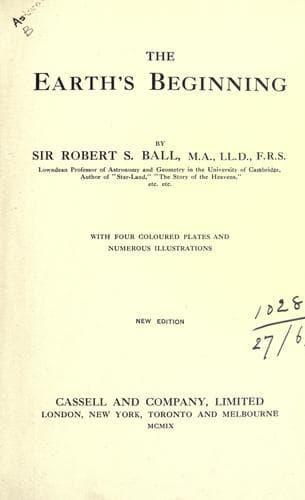
The Earth's BeginningBall, Robert S. (Robert Stawell)
Science
The Earth's Beginning
Ball, Robert S. (Robert Stawell)
Krakatoa (Indonesia); Nebular hypothesis
As the system advances in development, we have to deal with a gradual
decline in the ratio of the original store of energy to the original
store of moment of momentum. And hence we must expect that a system will
ultimately tend towards a form in which, while preserving its moment of
momentum, it shall do so with such a distribution of the bodies of which
it consists as shall be compatible with a diminishing quantity of
energy. It is not hard to see that in the course of ages this tends, as
one consequence, to make the movements of each of the bodies in the
system ultimately approximate to movements in a plane.
Let us, for simplicity, begin with the case of three attracting
particles, A, B and C. Let B be started in any direction in the plane L,
and let A be started in an orbit round it, and in the same plane L. Now
let C be started into motion, in any direction, from some point also in
L. It is certain that the sum of the areas projected parallel to any
plane, which are described in a second by these three bodies, must be
constant, each of the areas being, as usual, multiplied by the mass of
the corresponding body. Let us specially consider the plane L in which
the motions of A and B already lie. It is on this plane that the area
described by C has to be projected. The essential point now to remember
is that the projected area is less than the actual area. It is plain
that if C has to describe a certain projected area in a certain time,
the velocity with which C has to move must be greater when C starts off
at an inclination to the plane than would have been necessary if C had
started in the plane, other things being the same. Thus we see that, if
the three bodies were all moving in the same plane, they could, speaking
generally, maintain more easily the requisite description of areas, that
is, the requisite moment of momentum with smaller velocities than if
they were moving in directions which were not so regulated; that is to
say, the moment of momentum can be kept up with less energy when the
particles move in the same plane.
In a more general manner we see that any system in which the bodies are
moving in the same plane will, for equal moment of momentum, require
less energy than it would have done had the bodies been moving in
directions which were not limited to a plane. Thus we are led to the
conclusion that the ultimate result of the collisions and the friction
and the tides, which are caused by the action of one particle on
another, is to make the movements tend towards the same plane.
Public-domain text, read in full here on John Shaqi.
Reviews
Reviews
No reviews yet
Be the first to share your thoughts on this work.
Elsewhere in the archive
Join the Discussion
Join the discussion
Sign in to leave a comment or review.
Sign InorCreate an account