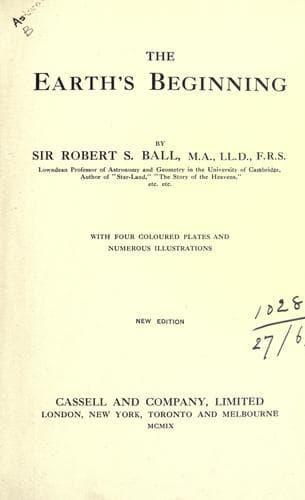
The Earth's BeginningBall, Robert S. (Robert Stawell)
Science
The Earth's Beginning
Ball, Robert S. (Robert Stawell)
Krakatoa (Indonesia); Nebular hypothesis
But having said this much as to the conceivability of the initiation of
a system with no moment of momentum, we now hasten to add that, so far
as Nature is actually concerned, this bare possibility may be set aside
as one which is infinitely improbable. Nature does not do things which
are infinitely improbable, and, therefore, we may affirm that all
material systems, with which we shall have to deal, do possess moment of
momentum. However the system may have originated, whatever may have been
the actions of forces by which it was brought into being, we may feel
assured that the system received at its initiation some endowment of
moment of momentum, as well as of energy. Hence we may conclude that
every such system as is presented to us in the infinite variety of
Nature, must stand in intimate relation to some particular plane, being
that which is known as the principal plane of moment of momentum. In our
effort to interpret Nature, the physical importance of this fact can
hardly be over-estimated.
In a future chapter we shall make some attempt to sketch the natural
operations by which individual systems have been started on their
careers. Postponing, then, such questions, we propose to deal now with
the phenomena which the principles of dynamics declare must accompany
the evolution of a system under the action of the exclusive attraction
of the various parts of that system for each other. The system commences
its career with a certain endowment of energy, with a certain endowment
of moment of momentum, and with a certain principal plane to which that
moment of momentum is specially related. In the course of the evolution
through which, in myriads of ages, the system is destined to pass, the
energy that it contains will undergo vast loss by dissipation. On the
other hand, the moment of momentum will never vary, and the position of
the principal plane will remain the same for all time. We have to
consider what features, connected with the evolution, may be attributed
to the operation of these dynamical laws. We have, in fact, to deduce
the consequences which seem to follow from the fact that, in consequence
of collisions, and in consequence of friction, an isolated system in
space must gradually part with its initial store of energy, but that,
notwithstanding any collisions and any friction, the total moment of
momentum of the system suffers no abatement.
Public-domain text, read in full here on John Shaqi.
Reviews
Reviews
No reviews yet
Be the first to share your thoughts on this work.
Elsewhere in the archive
Join the Discussion
Join the discussion
Sign in to leave a comment or review.
Sign InorCreate an account