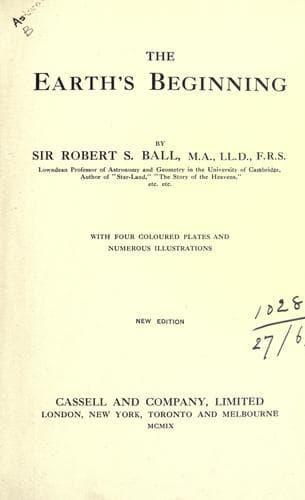
The Earth's BeginningBall, Robert S. (Robert Stawell)
Science
The Earth's Beginning
Ball, Robert S. (Robert Stawell)
Krakatoa (Indonesia); Nebular hypothesis
As the ages roll by, the nebula must gradually come to dispose itself,
so that the moment of momentum shall be maintained, notwithstanding that
the energy may have wasted away to no more than a fraction of its
original amount. Originally there was, of course, one plane, in which
the moment of momentum was a maximum. It is what we have called the
principal plane of the system, and the evolution tends in the direction
of making the nebula gradually settle down towards this plane. We have
seen that the moment of momentum can be sustained with the utmost
economy of energy by adjusting the movements of the particles so that
they all take place in orbits parallel to this plane, and the mutual
attractions of the several parts will gradually tend to bring the planes
of the different orbits into coincidence. Every collision between two
atoms, every ray of light sent forth, conduce to the final result. Hence
it is that the nebula gradually tends to the form of a flat plane. This
is the first point to be noticed in the formation of a spiral nebula.
But there is a further consideration. As the nebula radiates its light
and its heat, and thus loses its energy, it must be undergoing continual
contraction. Concurrently with its gradual assumption of a flat form,
the nebula is also becoming smaller. Here again that fundamental
conception of the conservation of moment of momentum will give us
important information. If the nebula contracts, that is to say, if each
of its particles draws in closer to the centre, the orbits of each of
its particles will be reduced. But the quantity of areas to be described
each second must be kept up. We have pointed out that it is infinitely
improbable the system should have been started without any moment of
momentum, and this condition of affairs being infinitely improbable, we
dismiss any thought of its occurrence. As the particles settle towards
the plane, the areas swept out by the movements to the right, and those
areas swept out by the movements to the left, will not be identical;
there will therefore be a balance on one side, and that balance must be
maintained without the slightest alteration throughout all time. As the
particles get closer together, and as their orbits lessen, it will
necessarily happen that the velocities of the particles must increase,
for not otherwise can the fundamental principle of the constant moment
of momentum be maintained. And as the system gets smaller and smaller,
by contraction from an original widely diffused nebulosity, like,
perhaps, the nebula in Orion, down to a spiral nebula which may occupy
not a thousandth or a millionth part of the original volume, the areas
will be kept up by currents of particles moving in the two opposite ways
around a central point. As the contraction proceeds, the opposing
particles will occasionally collide, and consequently the tendency will
be for the predominant side to assert itself more and more, until at
Public-domain text, read in full here on John Shaqi.
Reviews
Reviews
No reviews yet
Be the first to share your thoughts on this work.
Elsewhere in the archive
Join the Discussion
Join the discussion
Sign in to leave a comment or review.
Sign InorCreate an account