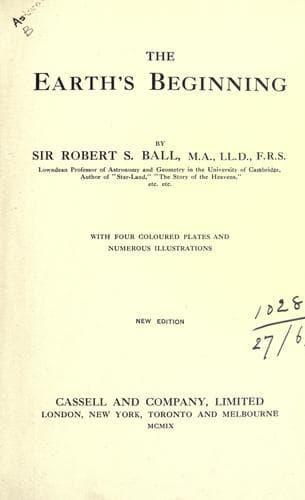
The Earth's BeginningBall, Robert S. (Robert Stawell)
Science
The Earth's Beginning
Ball, Robert S. (Robert Stawell)
Krakatoa (Indonesia); Nebular hypothesis
last we may expect a condition to be reached in which all the movements
will take place in one direction, and when the sum of the areas
described in a second, by each of the particles, multiplied by their
respective masses, will represent the original endowment of moment of
momentum. Thus we find that the whole object becomes ultimately
possessed of a movement of rotation.
The same argument will show that the inner parts of the nebula will
revolve more rapidly than those in the exterior. Thus we find the
whirlpool structure produced, and thus we obtain an explanation, not
only of the flatness of the nebula, but also of the spiral form which it
possesses. It is not too much to say that the operation of the causes we
have specified, if external influence be withheld, tends ultimately to
produce the spiral, whatever may have been the original form of the
object. No longer, therefore, need we feel any hesitation in believing
the assurance of Professor Keeler that out of the one hundred and twenty
thousand nebulæ, at least one-half must be spirals. We have found in
dynamics an explanation of that remarkable type of object which we have
now reason to think is one of the great fundamental forms of nature.
------------------------------------------------------------------------
CHAPTER XII.
THE EVOLUTION OF THE SOLAR SYSTEM.
The Primæval Nebula—A Planetary Nebula—The Progress of its
Evolution—Unsymmetrical Contraction—Centres of Condensation—The Form
ultimately assumed—Difference between Small Bodies and Large—Earth
and Sun—Acceleration of Velocities—Formation of the Subordinate
Systems—Special Circumstances in the case of the Earth and Moon—Vast
Scale of the Spirals—Spectra of the Spiral Nebulæ.
WE shall consider in this chapter what we believe to have been the
history of that splendid system, formed by the planets under the
presiding control of the sun. The ground over which we have already
passed will prepare us for the famous doctrine that the sun, the planets
and their satellites, together with the other bodies which form the
group we call the solar system, have originated from the contraction of
a primæval nebula.
As the ages rolled by, this great primæval nebula began to undergo
modification. In accordance with the universal law which we find obeyed
in our laboratories, and which we have reason to believe must be equally
obeyed throughout the whole extent of space, this nebula, if warmer than
the surrounding space, must begin to radiate forth its heat. We are to
assume that the nebula does not receive heat from other bodies, adequate
to compensate for that which it dissipates by radiation. There is thus a
loss of heat and consequently the nebula must begin to contract. Its
material must gradually draw together, and must do so under the
operation of those fundamental laws which we have explained in the last
chapter.
Public-domain text, read in full here on John Shaqi.
Reviews
Reviews
No reviews yet
Be the first to share your thoughts on this work.
Elsewhere in the archive
Join the Discussion
Join the discussion
Sign in to leave a comment or review.
Sign InorCreate an account